This is a rigid cylindrical paper tube we manufactured for a fragranced candle, produced in a run of 10,000 pieces. It has a fitted lid, a twisted natural rope handle attached at opposite sides of the tube wall, and a two-tone surface: a dark, textured brown upper section over a charcoal-grey lower wrap. It works as custom candle paper tube packaging that doubles as a carry-and-gift package, and what sets it apart from a plain paper tube is the way the handle, the lid and the surface treatment are designed to work together.
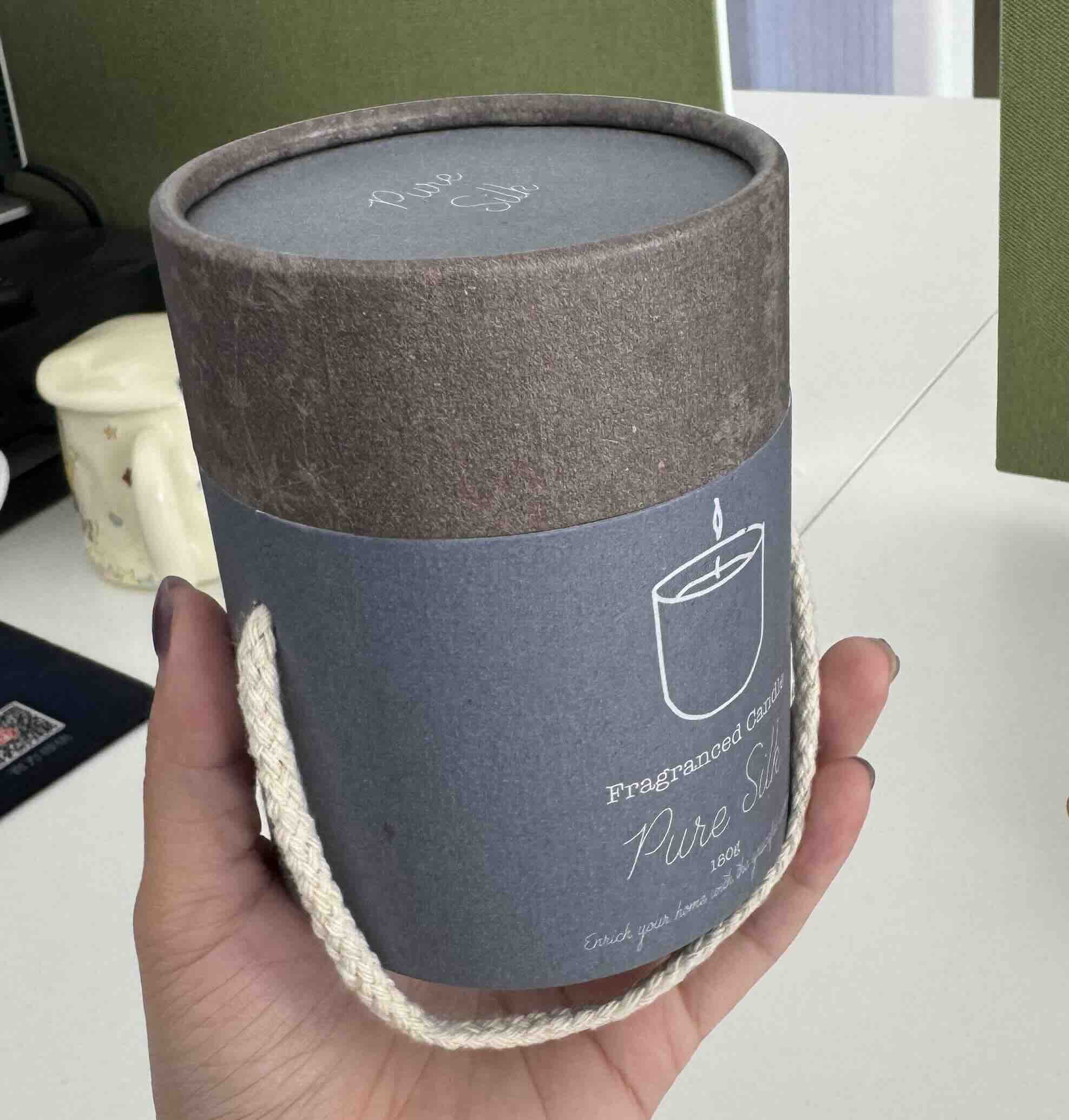
Lift this tube by its rope and the handle, not the body, takes the load. A rope attached at opposite sides of a cylinder turns it into something carried like a small bag. With a plain tube you hold the body in your hand. Here the hand takes the rope and the tube hangs below it, which changes how the package is carried, shown and handed over.
The rope is long enough to carry the package from above. The fitted lid has a dark top surface that matches the body, and a minimalist white line drawing of a candle is the only graphic on the front. Nothing about it looks heavily decorated.
A folding carton arrives flat, is erected by the filler and is held by tuck flaps or glue. It has square corners, a thin wall and no built-in way to carry it. A standard paper tube gives you a rigid cylinder and a lid, and the finishing stops there. This package adds two functional features on top of that rigid cylinder: a handle that carries load, and a surface that changes from one section to the next. We are not claiming this format is unique, since rope-handled cylinders exist in the wider market. What we can describe is how this particular one was approached.
A package like this is a set of decisions that have to agree with each other. The notes below are the engineering considerations behind a construction of this type. They describe how we approach this kind of project in general, and they are not a record of tests on this particular run.
The first decision is the cylinder itself. The inside diameter and height are set by the candle, with enough clearance that the candle goes in and comes out freely but does not rattle. The lid comes next. It must grip the body enough to stay on when the package is carried by the rope, and still lift off easily. Too tight and it is awkward to open. Too loose and it can fall away when the tube is lifted.
Then the surface. A decorative wrap has to be positioned against the tube body. On a cylinder, the wrap edges and the seam are always in view, so even a small shift is easy to see. The proportion between the brown upper section and the charcoal lower wrap also has to stay the same from piece to piece, because the eye reads that boundary line immediately.
The brown upper section looks textured, and the charcoal wrap below it reads as a more uniform band. That contrast is what gives the package its character. A textured dark surface reads as tactile and slightly rustic. The grey wrap adds structure and a clear place for the graphic. The natural-colored rope contrasts with both and is the only light element besides the white drawing.
A premium look does not need foil or elaborate artwork here. The palette is restrained, the typography is small and the geometry is simple, so the quality comes from the materials and proportions. Dark, matte-looking surfaces also show scuffs and fingerprints more easily than light ones, which is a production consideration we come back to below.
Adding a handle to a cylinder is a structural decision. When the package is lifted, the whole weight of the tube and candle is carried through two points on the tube wall. Paperboard is strong along its length and weaker where a hole or a pull concentrates stress, so the way a rope is anchored matters. The usual options include knotting inside the wall, using a stop or reinforcing the wall around the opening. We have not disclosed how this one is attached, and the photographs do not show it.
Position matters as much as strength. The two attachment points must sit exactly opposite each other and at the same height. If they are offset, the tube tilts when it is lifted. Their height on the body also affects balance. Rope length decides how high the package hangs and whether the rope clears the lid. If it is too short, it pulls against the lid. If it is too long, the package swings.
Visually the rope becomes part of the design. Its natural color and twisted texture are what a customer sees first, and the handle gives the package a recognizable outline. That is why the choice of rope and its attachment are decided with the tube, not added at the end. We make no claim that this exact package has passed a particular strength or drop test.
A single sample proves a design. A run of 10,000 proves that it can be repeated. Several kinds of variation matter in a package like this, and an engineer watches for them.
Lid fit is one: if the body diameter drifts across the run, some lids will be tight and some loose. Wrap alignment is another, since a small shift is easy to see on a two-tone cylinder. Handle position is a third: attachment points that move up or down, or around the circumference, change how the tube hangs. Finally, dark surfaces show cosmetic damage clearly, so scratches, rub marks and color differences between the brown and the charcoal need to be controlled from batch to batch.
Each of these is found by comparing pieces with an approved sample and by handling real pieces: fitting the lid, lifting by the rope, looking at the seam. We are not publishing defect rates, inspection figures or timelines for this run.
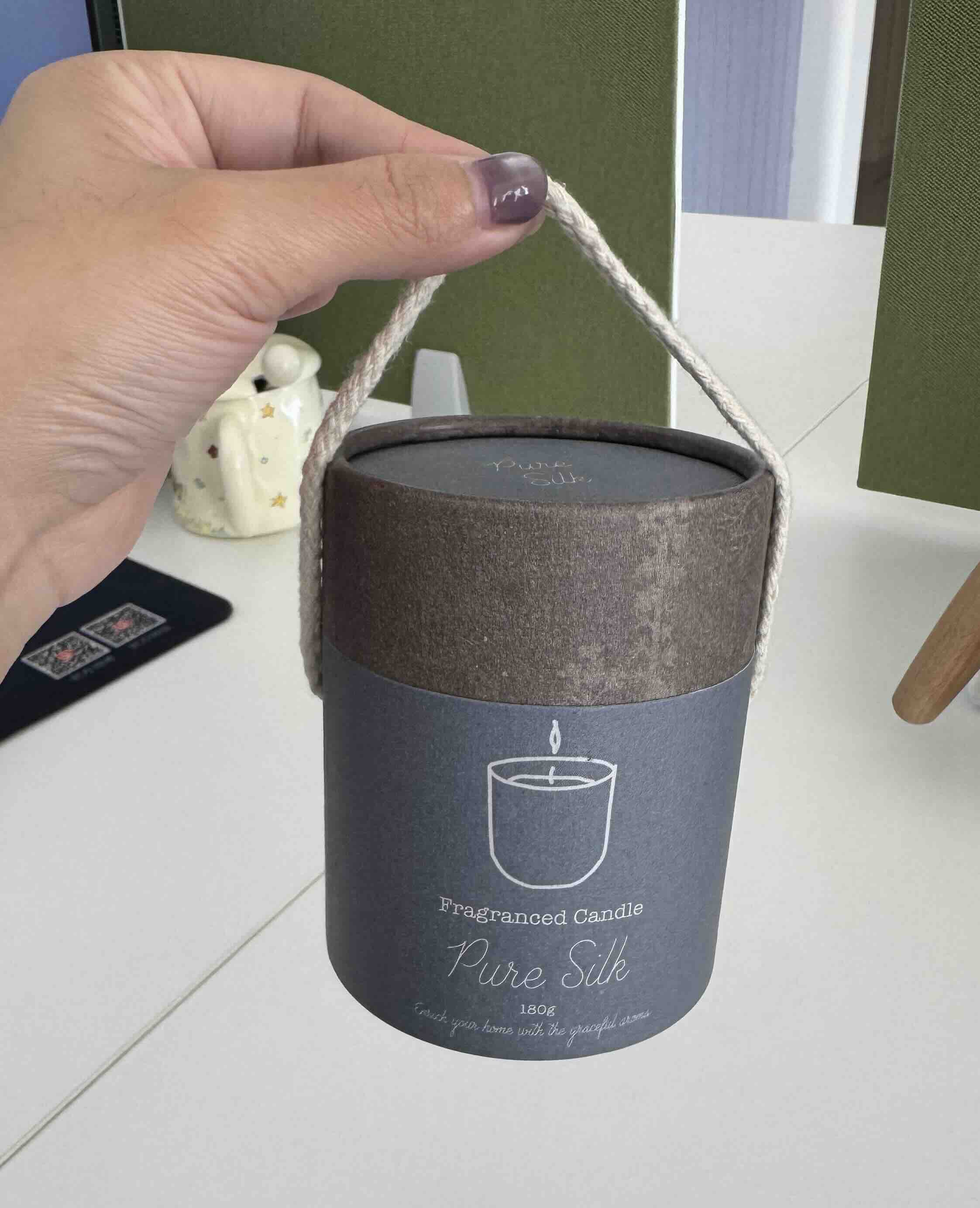
On a shelf, a dark cylinder with a rope stands out from the rows of square boxes beside it. In the hand, the handle invites a customer to pick it up and carry it, and the weight and texture are what they experience before anything is opened. As a gift, it is already a carryable package, so it may need less additional wrapping. Lifting the lid is the first physical interaction with the candle, so the fit of the lid contributes to how the product feels. These are observations about presentation. We have no measured figures on sales, conversion or customer satisfaction for this project.
Project at a glance
Product packed: a fragranced candle
Format: rigid cylindrical paper tube with fitted lid
Handle: twisted natural rope attached at opposite sides
Surface: textured dark brown upper section, charcoal-grey lower wrap, white line illustration
Production quantity: 10,000 pieces
Nothing here is complicated alone. A cylinder, a lid, a rope and two surface treatments are ordinary parts. What makes the package distinctive is that they were planned together: the lid has to survive carrying, the rope has to be placed precisely, the wrap has to line up, and all of it has to repeat across 10,000 pieces.
If you are planning candle paper tube packaging with a handle or another added feature, send Earthycores the candle dimensions and weight, the quantity and the look you want, and we will tell you what the construction needs. You can also see our wider range as a custom paper tube manufacturer.