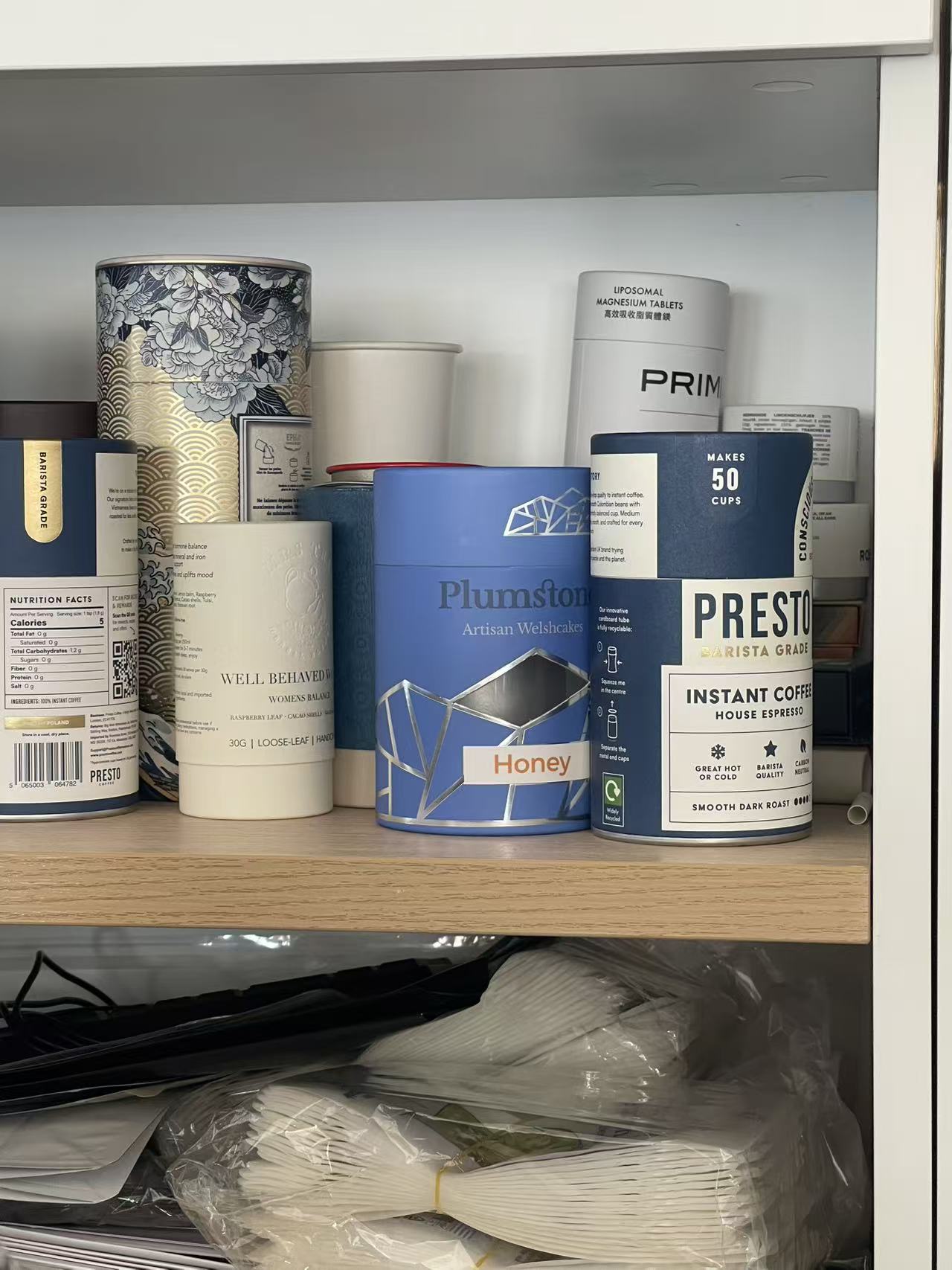
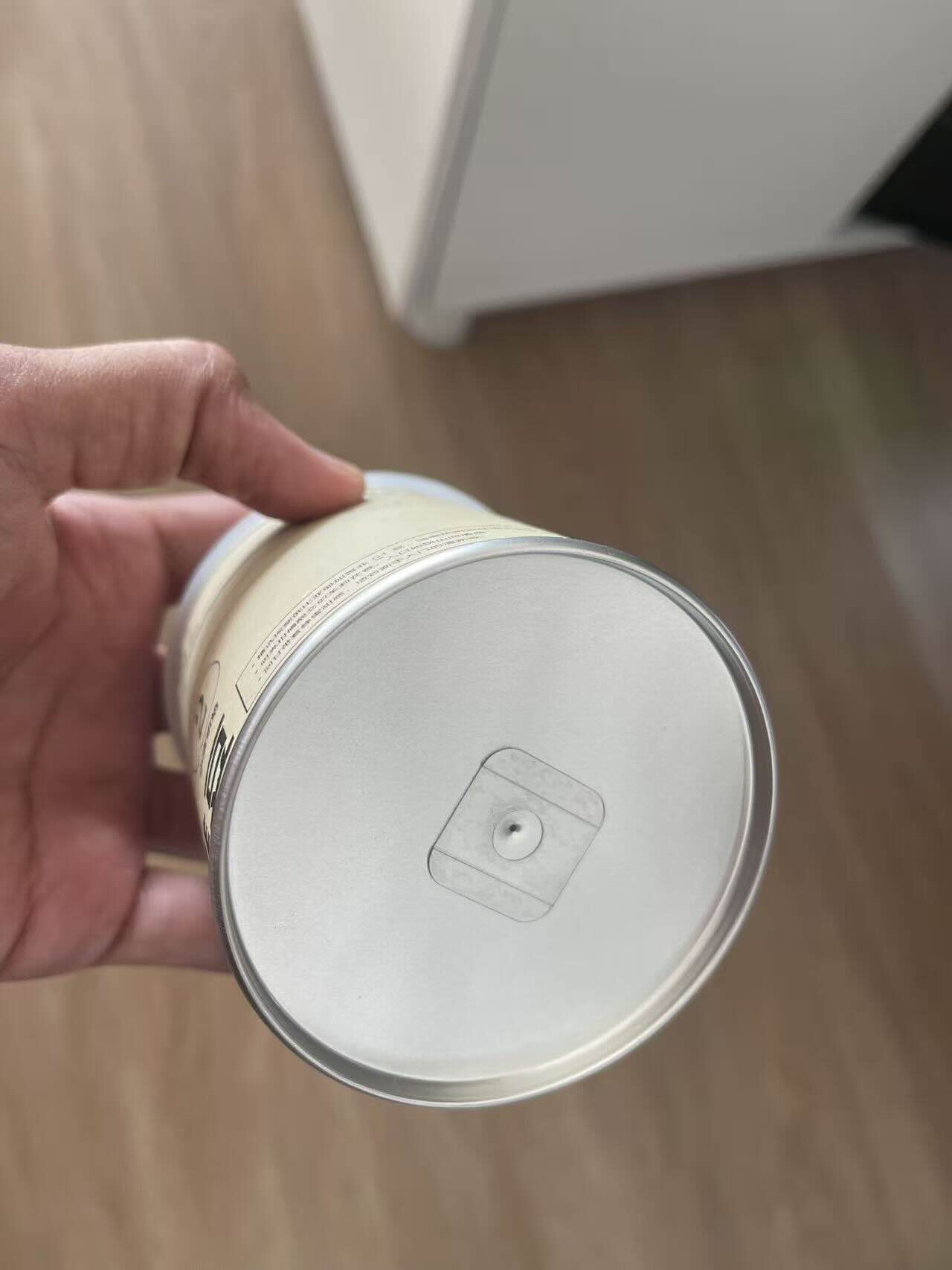
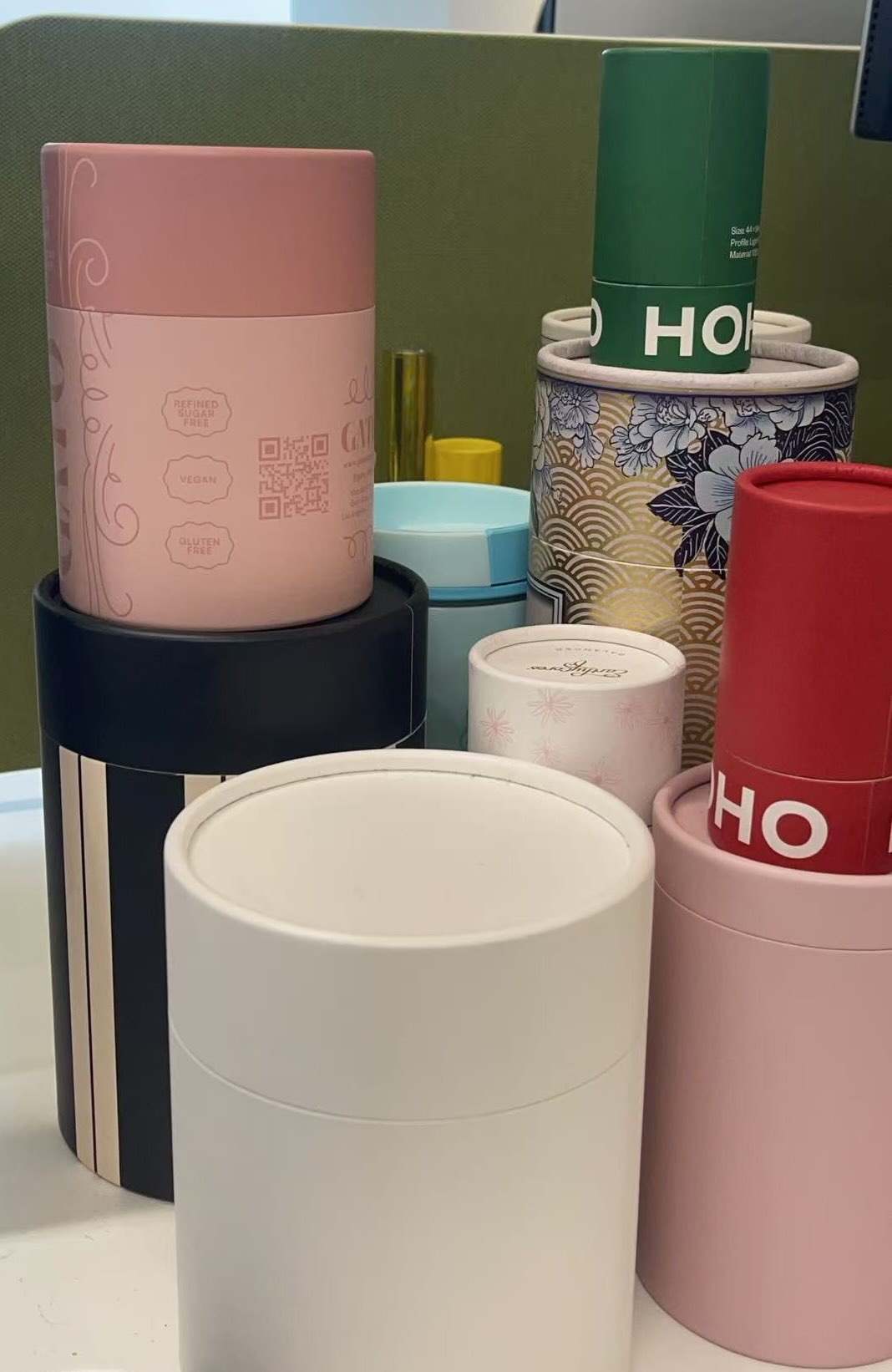
The standard retail unit is the three-ball sleeve: a printed paperboard band open at both ends, holding three balls end to end. Four sleeves fit in a carton for a dozen. A sleeve holds the balls by friction, ships flat before filling, and costs little per unit. Custom golf ball sleeves keep that structure and change only the print and board.
Rigid golf ball boxes are built differently. A setup box with a hinged or lift-off lid contains an insert with one cavity per ball, so each ball is held separately. We make rigid golf ball boxes with paperboard inserts, with optional magnetic closures, and our standard minimum for custom boxes is 10,000 units.
Paper tube packaging stacks the balls vertically in a narrow rigid cylinder closed with a lid. Our golf ball tube packaging is made this way, and custom printed tubes start at 1,000 units per design. Corrugated cartons sit outside all three, as the shipping layer, not the retail pack.
Rack retail is built around sleeves and cartons, so a tube is rarely the right format there. Gift sets, promotional packs and direct sales suit tubes and rigid boxes, where the pack is displayed or kept.
Coated folding carton board is a few tenths of a millimeter thick and prints sharply, which is why sleeves and cartons use it. Corrugated board adds a fluted layer between two liners, and its resistance to stacking load depends on the flute profile and the liner strength, often reported as edge crush values. Rigid boxes use thick greyboard wrapped in printed paper. Kraft paper gives an uncoated brown surface and is common on plain stock tubes.
A paper tube body is a laminate of paperboard layers bonded into a cylinder, with printed paper wrapped on the outside. Wall thickness comes from the number and thickness of the layers, and stiffness rises faster than thickness does, so a modest increase in wall resists crushing noticeably better. Direction of load matters too. A tube standing on end carries stacking load along its axis, which it handles well. A tube lying on its side under pressure is squeezed across its diameter and can go oval, which is the weaker direction. Our tube bodies are built from bonded paperboard layers, and the construction varies with diameter, height and load.
Paperboard takes up moisture from humid air and loses stiffness as it does. A tube that is firm in a dry warehouse can soften during a long sea shipment. Inserts are either paperboard or molded plastic. Paperboard keeps the pack paper-based, and plastic holds its shape better but changes what can be recycled.
The Rules of Golf set a minimum golf ball diameter of 42.67 mm and a maximum weight of 45.93 g, so designers work from a known size. The design variable is clearance.
An illustrative three-ball tube, with assumptions stated: three balls stacked measure about 128 mm (3 x 42.67 mm). With 2 mm of total clearance across the diameter, the inside diameter is near 45 mm. The inside height needs the stack plus the depth of the lid seat, so it must exceed 128 mm. With a 2 mm wall, the outside diameter is about 49 mm. These are example figures, not an Earthycores specification.
Each dimension fails in a predictable way:
Inside diameter too small: the balls bind on the wall and are hard to pull out. Sleeves fail the same way when print and board thickness consume the clearance.
Tube taller than needed: a four-ball tube holding three balls leaves about 43 mm of free length, so the balls slide and rattle.
Height too short: if the stack plus lid seat exceeds the inside height, the lid rests on the top ball and does not close.
Lid tolerance: suppose a lid is designed for 0.3 mm of interference on the diameter. If body outside diameter varies by 0.4 mm either way from tube to tube, some lids will grip and some will fall off.
In rigid boxes, a cavity should hold roughly half the ball's height or more, or the ball can roll out when the lid opens. Samples are checked with real balls and real lids for these reasons.
We print paper tubes by digital and offset printing, with custom colors and artwork. Digital printing suits smaller or varied runs, and offset printing suits repeatable designs. The outer paper is printed and inspected before it is converted into a tube. Brand colors that must match exactly are normally specified as spot colors, so state this at the start.
Finishes we offer are matte, gloss, foil stamping, embossing, debossing, Spot UV, die-cut windows and locking or closure structures, depending on the structure. Not every finish suits every tube or box, and we confirm each against the actual design.
Scale matters on a small cylinder. A 49 mm tube has a circumference of about 154 mm (π x 49), so a wrap that shifts by 2 mm is visible at the seam and on any logo that crosses it. Registration, meaning the alignment of printed layers, and wrap position are therefore inspected closely.
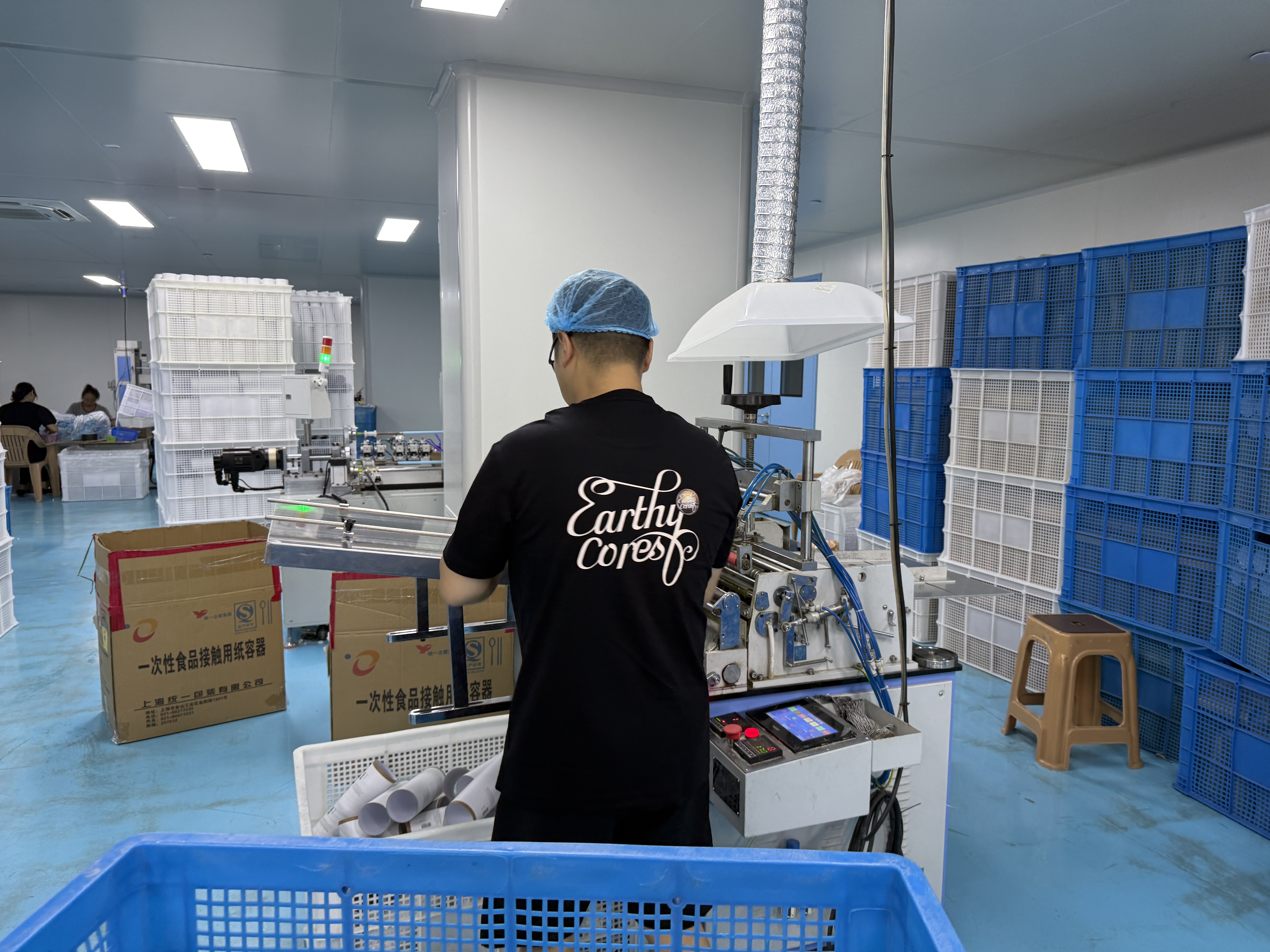
Printing during Earthycores paper tube production.
Earthycores: our factory photographs document this order: printing, inspection after printing, tube body forming, cutting to height, edge finishing, cap and head production, component inspection, assembly, final inspection and finished stock. Production is at our own facility in China. See the factory process article for each stage.
What happens at each stage, and the usual fault:
Forming and cutting: the body is formed from bonded paperboard layers and cut to length. A body formed slightly oval or cut to a varying height affects every later fit, because lids and bases are matched to a round body of a set height.
Edge finishing: the cut edge is smoothed so the lid seats cleanly. A rough edge catches the lid and can fray.
Cap and head production: these parts are made separately. If their size drifts, lid grip drifts with it.
Assembly: parts are joined while the printed wrap stays aligned. Misalignment at this point is visible in the finished pack.
Typical production time is about 20 days after specifications are finalized, and it excludes shipping. Published capacity exceeds 500,000 tubes per month across all products, which is not a commitment for any single order. We do not publish equipment details or tolerances.
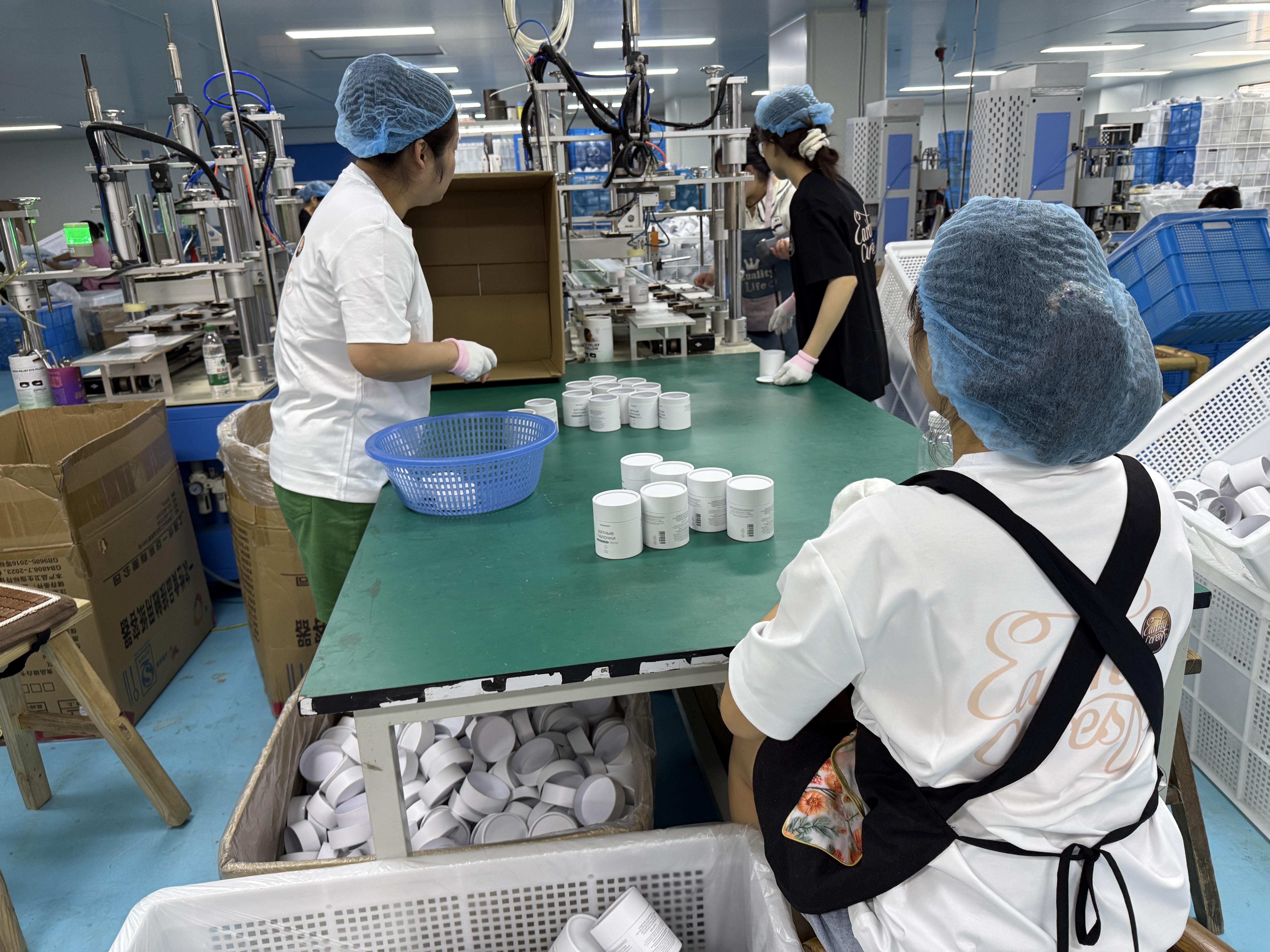
Assembly of custom paper tube packaging at Earthycores.
Earthycores: our factory photographs document three inspection points: printed material after printing, components before assembly, and finished tubes before packing. Final inspection considers diameter and height against the approved specification, printed appearance, dents or deformation, edges, closure fit and function, surface marks and packing. We do not publish tolerances, defect rates or an inspection standard.
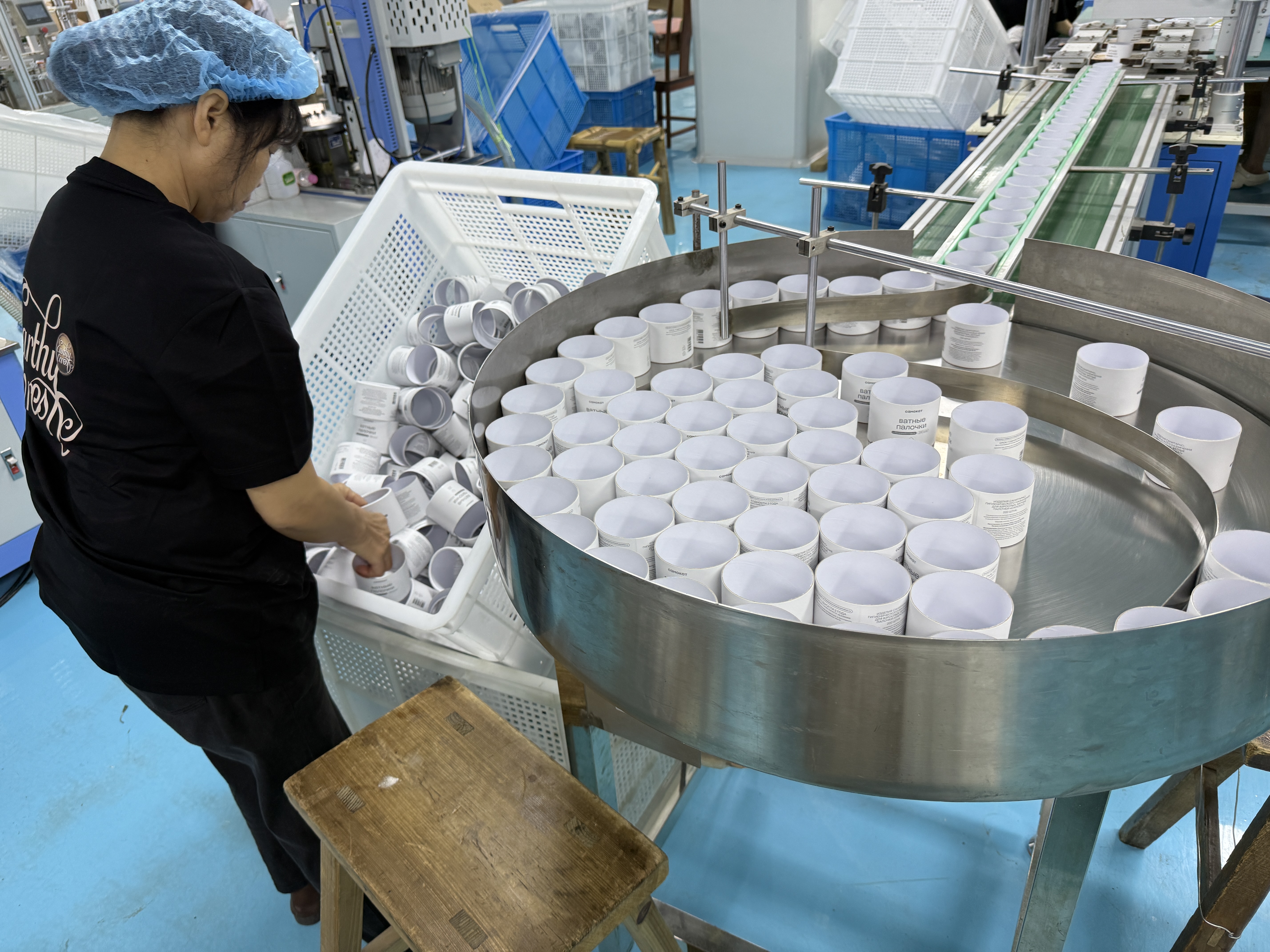
Inspection after printing during Earthycores paper tube production.
General practice: diameter and height are usually measured with calipers or fixed gauges. Readings are taken at several points around the tube, because a slightly oval tube gives a correct reading at one angle and a wrong one at another. Samples from the start, middle and end of a run show whether dimensions drift. Lid fit is checked by assembling real parts and opening and closing them repeatedly. Print inspectors look for registration shift, color that differs from the approved sample, specks, scratches, rub marks and a misaligned seam.
Quality control finds defects in the product. Quality assurance is the system around it: an approved sample and specification, set checks at defined stages, and a response when a check fails. Bulk production is judged against the approved sample, so the sample is the reference for every later check.
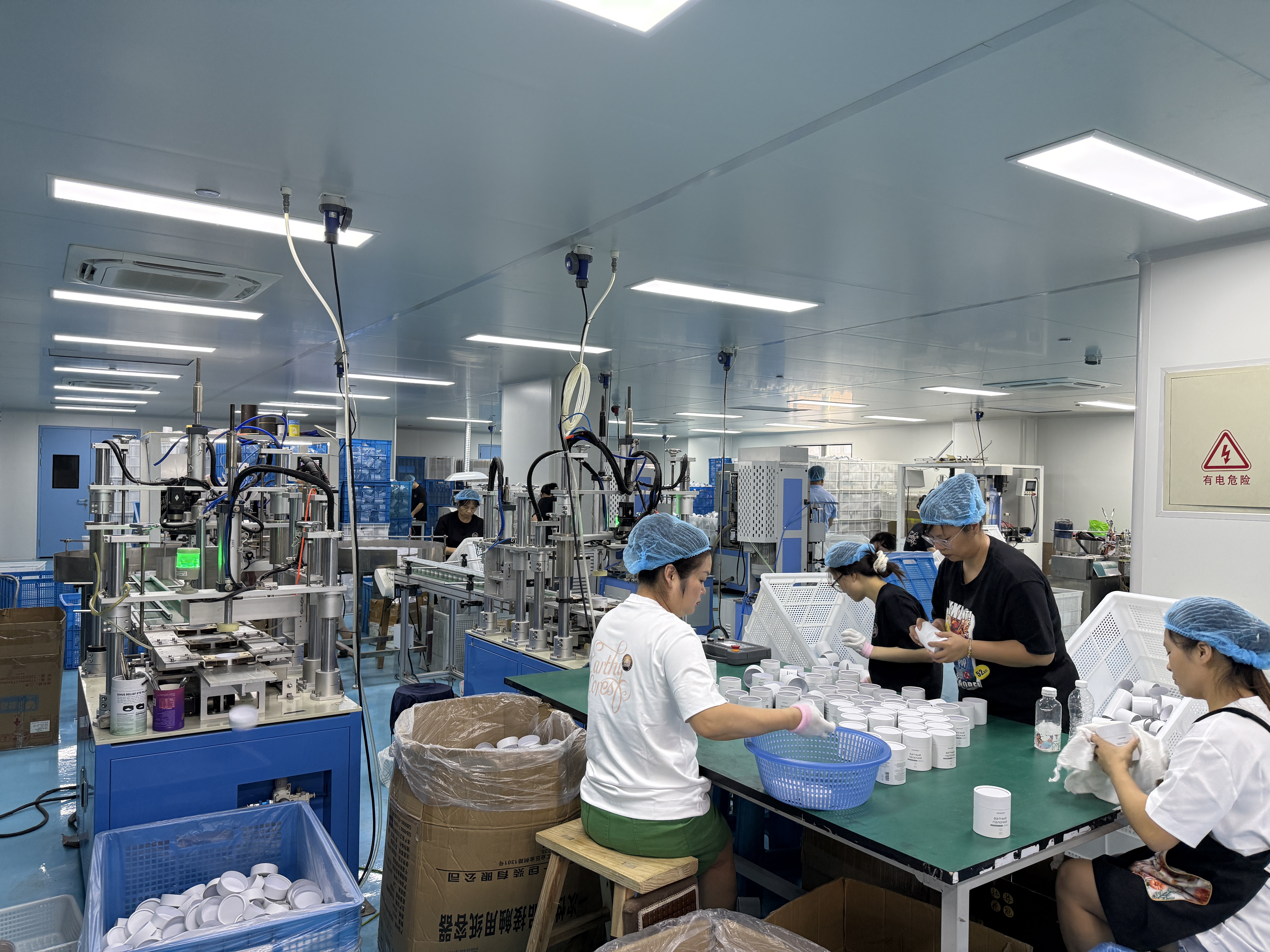
Finished paper tubes undergoing final quality inspection at Earthycores.
General practice: inspection shows whether a pack measures and looks right. Testing shows whether it survives. A compression test loads the pack between platens and records the load at deformation. The result is compared with the expected load, which is the weight of the cartons above times a safety factor. For example, if cartons weighing 5 kg each are stacked five high (an assumed case), the bottom carton carries about 20 kg before any safety factor, and the balls alone in a three-ball tube weigh up to about 138 g (3 x 45.93 g). A drop test checks survival from a set height. A vibration test simulates road transport, and humidity conditioning shows how the board reacts to moisture. ASTM D4169 and the ISTA procedures define combined test sequences for shipped packages.
These tests need laboratory equipment or an independent lab and are most useful for large or high-value programs. Earthycores does not publish test results, so buyers who need them should specify independent testing for the actual pack.
Cost follows the specification: quantity, dimensions, wall thickness, print, finishes, inserts, assembly and sample development. Unit price falls as quantity rises because setup is spread over more units. A lower quote can still cost more overall if the pack dents in transit or needs repacking.
Freight matters more for rigid formats. A circle fills about 78.5 percent of the square around it (π/4), so tubes in a square grid leave over a fifth of the carton cross-section empty. Staggering recovers some, but real cartons rarely pack perfectly. Sleeves ship flat and take almost no space. Compare quotes on the same structure, finish and delivery terms, and confirm sample charges for custom work.
A paper pack can replace plastic, but a paper tube is not automatically recyclable, compostable or plastic-free. Coatings, laminations, plastic inserts and mixed-material closures change the result, and local recycling rules vary. We offer FSC-certified material options, which relate to forest sourcing of the paper, not to the recyclability of the finished pack, and we confirm scope per order. Our full-paper tubes reduce non-paper parts.
Standard retail racks: a sleeve or folding carton.
Gift sets or promotional packs from about 1,000 units: a custom printed tube.
Premium sets with a compartment per ball: a rigid box, planned from 10,000 units.
Test a sample with real balls and the real lid before approving production.
Ask for the inside diameter, inside height and clearance, not only the outside size.
Confirm what is inspected, at which stage, and whether any testing is done in-house or by a third party.
Check carton volume for the packed order before comparing freight.