Degassing valve on paper tube
EarthyCores is one of the leading manufacturers of coffee paper tubes because of our simple and durable mechanical techniques. One of them is the one-way degassing valve fitted into coffee paper tubes.
This is not something we started producing recently. We have been making these tubes for years, and hundreds of coffee roasting companies have purchased them from us. Our customers have been happy with the results.
We know EarthyCores is not the only manufacturer producing coffee tubes with degassing valves. But after producing millions of tubes, we have gained enough experience to understand even the small details of this process.
We continue improving the fitting, sealing and overall construction of these tubes. Our aim is to make them more reliable and help roasted coffee stay fresh for longer.
Fresh roasted coffee beans do not stop releasing gas when the roasting is finished. They continue to release carbon dioxide (CO₂) for some time after roasting. If the coffee is packed into a closed tube, this gas has nowhere to go.
A coffee tube with a degassing valve gives the gas a way out. The main purpose of the valve is to let the excess carbon dioxide leave the tube without letting outside air come in through the same opening. This is the reason roasters ask for coffee packaging with a degassing valve when they want to pack coffee for sale.
The valve we use is a one-way degassing valve. It is a small mechanical part, and it works by itself. The roaster does not need to press it, open it or close it by hand.
The roasted coffee beans are packed in the tube and the tube is closed.
The beans continue to release carbon dioxide after packing.
The gas slowly collects inside the tube, and the pressure inside starts to increase.
When the pressure inside is higher than outside by enough difference, the valve opens.
The extra carbon dioxide escapes through the valve.
When the pressure comes down, the valve closes again.
The same cycle can repeat as long as the coffee keeps releasing gas.
The valve is designed to restrict outside air from entering through the same opening. We should be clear about what this means. It does not remove all the oxygen from the tube. It does not create a vacuum. It also does not completely stop oxidation. It manages the gas pressure and limits air entering through the valve, and that is its job.
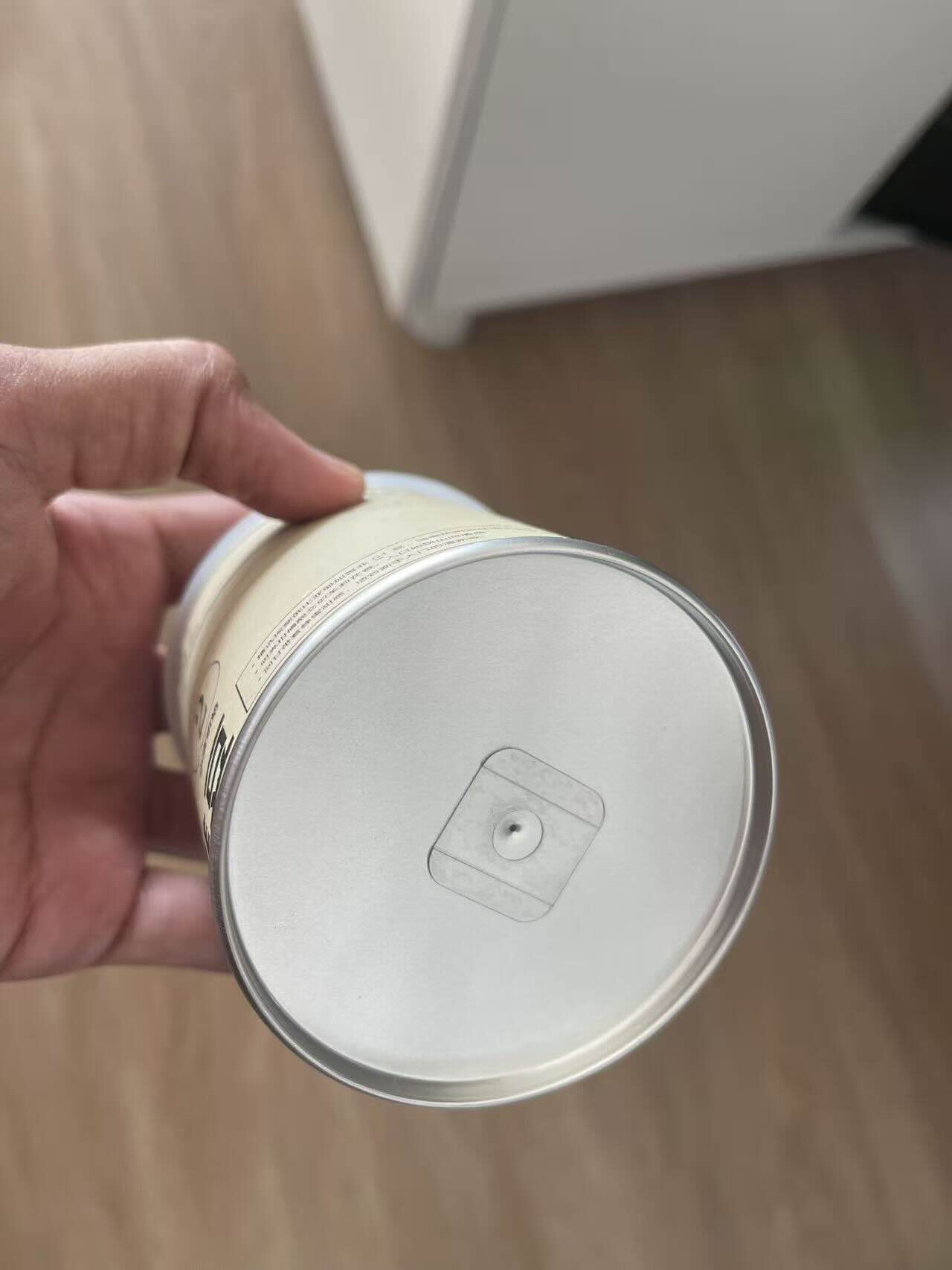
The tube shown in our photograph is a paper coffee tube with a silver metal bottom. The one-way valve is fitted into the centre of that metal bottom. The valve is a small part, but the fitting needs care, because the valve works properly only when it sits correctly in its opening.
First, the bottom component is prepared. A hole is made in the metal bottom for the valve. This opening must be suitable for the dimensions of the valve we are using.
If the hole is not correct, the problems start from this point. A hole that is too small can make the fitting difficult. A hole that is too large can leave the valve loose.
After the opening is ready, the one-way degassing valve is positioned at the centre of the metal bottom. Then it is fitted, or pressed, into the opening. The fitting must be secure, and the valve must sit properly aligned.
After fitting, our production team checks the assembled component for correct fitting and sealing. Then we perform pressure and leak testing to check the valve's performance. We explain this testing in a separate section below.
This small part can cause problems if it is not fitted correctly. A valve that is not seated properly can leak around its edge. In that case gas, and also air, can move through a path that the valve was never meant to control.
A valve that is not aligned can also behave differently from one tube to the next. For a roaster, this means inconsistent tubes in the same batch. This is why the opening size, the alignment and the fitting all need attention, and why we do not treat the valve as an accessory that is simply dropped in.
We perform pressure and leak testing on the fitted valve. We do this to check several things:
Whether the valve allows gas to escape as intended
Whether there is unwanted leakage
Whether the valve is fitted securely
Whether the fitting process is consistent from one tube to another
Testing also helps us find defects before the tubes reach the customer. It is much easier to correct a fitting problem in our factory than after a roaster has already filled the tubes with coffee. We do not publish pressure values or test numbers here, because those details depend on the valve and the tube construction used in each project.
The valve does one specific job well. It helps manage the gas pressure inside the tube, and it restricts outside air from entering through the valve. For roasters who pack coffee soon after roasting, this is a practical help.
But the freshness of coffee does not depend on the valve alone. It also depends on the barrier construction of the tube, the closure, the storage conditions, and the oxygen that was already inside the tube when the coffee was packed. A good valve in a poorly closed tube will not keep coffee fresh. We do not claim a fixed increase in shelf life, because we do not have test data that supports one number for all coffee and all conditions.
Yes. The valve in our photograph is fitted into a silver metal bottom, but it is not limited to metal-bottom tubes. A degassing valve can be installed in other suitable paper tube constructions, depending on their design and technical requirements.
Each construction has to be checked for where the valve can sit, how the opening is made, and how the fitting will hold. So we look at the actual tube design before we confirm that a valve can be used.
Our experience comes from repeated production, testing, fitting and improvement. After making this tube for years, we have seen which details affect the result: the size of the opening, how the valve is positioned, how securely it is fitted, and how consistently this is repeated across a large order.
We continue working on small improvements in the mechanical process. None of them is big on its own, but together they make the tube more reliable for the roaster.
Carbon dioxide forms during roasting and stays in the beans. After roasting, the beans continue to release it for some time. If the coffee is packed in a closed tube, this gas collects inside the tube.
The valve is designed to restrict outside air from entering through the same opening. We do not say it removes all oxygen or stops oxidation completely, because the rest of the tube construction and the packing conditions also affect this.
The valve gives the released gas a way out, which helps when coffee is packed soon after roasting. When to pack is the roaster's decision and depends on their own roast and process. We make the tube, and we do not set the roasting routine.
No. The tube in our photograph has a silver metal bottom, but the valve can also be installed in other suitable paper tube constructions, depending on the design and technical requirements.
It helps manage gas pressure, but we do not claim a specific shelf-life increase. Shelf life also depends on the tube's barrier construction, the closure, storage conditions and the oxygen present at packing.
We check the fitting and sealing of the assembled component, and we perform pressure and leak testing. This checks that gas can escape as intended, that there is no unwanted leakage, and that the valve is fitted securely.
EarthyCores manufactures coffee paper tubes for roasters, and the degassing valve is one small part of that work. If you are planning coffee packaging with a degassing valve, send us your tube size and the construction you have in mind, and we will tell you what is possible.