Enter dimensions in inches and box quantity.
Based on outside box dimensions.
Estimate carton space required for paper tubes.
Estimated shipping carton based on tube dimensions and quantity.
Knowing the dimensions of a single box or paper tube is only the first step in planning a shipment. Once an order moves from one sample to hundreds or thousands of units, buyers also need to estimate how much space that quantity will occupy once it's packed into shipping cartons.
Packaging dimensions affect more than the product inside them. They influence:
Master carton dimensions
Number of cartons required
Warehouse and storage space
Freight planning
Pallet planning
Shipping quotations
The two calculators on this page, a Box Shipping Volume Calculator and a Paper Tube Shipping Calculator, are built to help with this kind of early-stage planning. Both tools produce estimates useful for comparison and planning purposes. Neither one replaces a final freight quotation or a confirmed master carton specification from a manufacturer.
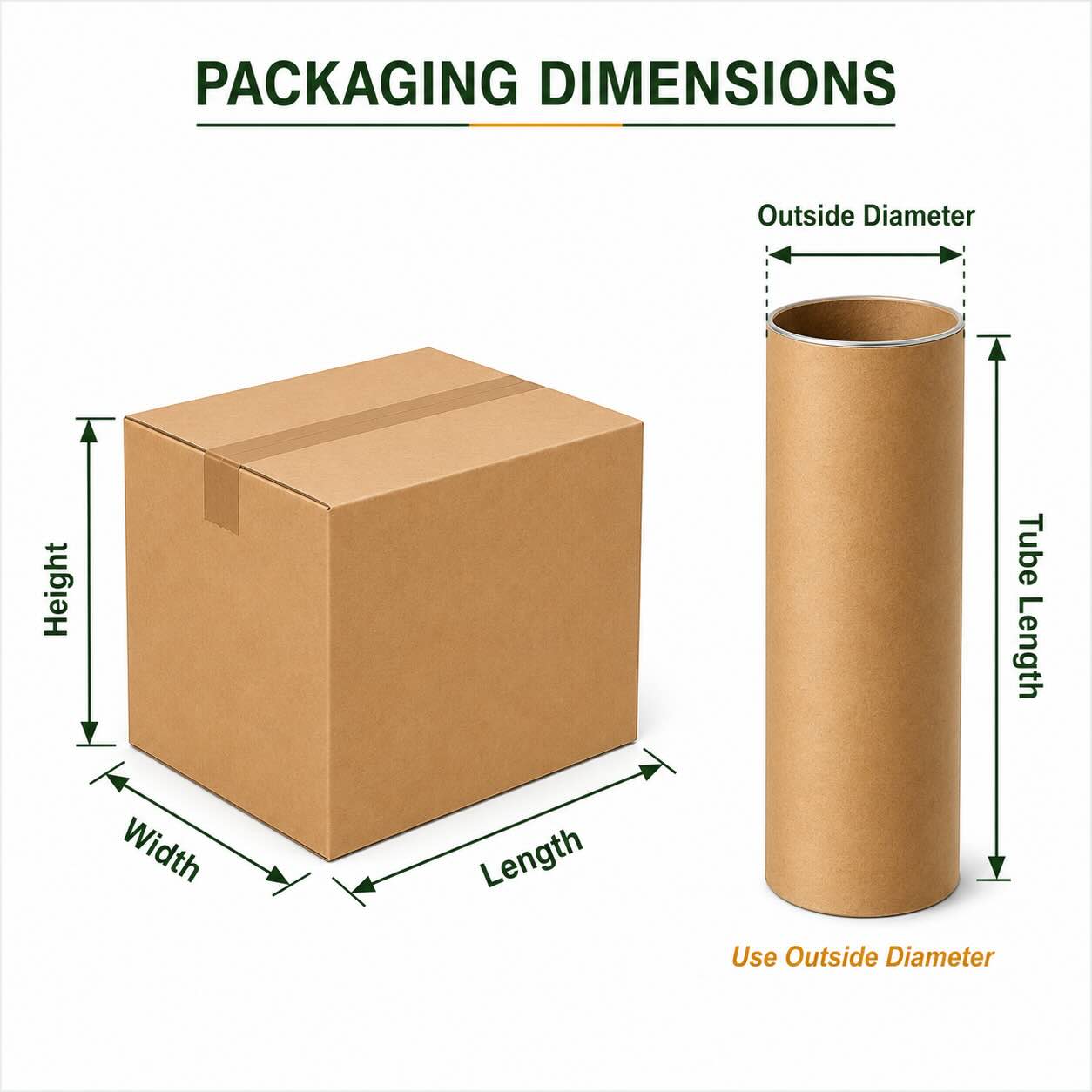 For a rectangular cardboard box, three measurements define its volume: length, width, and height. The distinction that matters most for shipping calculations is whether you're using outside dimensions or inside dimensions.
A box might be specified internally to fit a specific product, but the box occupies physical space in a carton, pallet, or container according to its external dimensions. When estimating shipping or storage volume, outside dimensions are almost always the correct figures to use, since that's the actual footprint the finished packaging takes up.
For paper tubes, there are four relevant measurements:
Outside diameter
Inside diameter
Tube length
Wall thickness
The Paper Tube Shipping Calculator requires the outside diameter, not the circumference. Outside diameter is relevant because when tubes are packed together, each tube physically occupies space according to how wide it is on the outside. A tube's inner diameter tells you about product fit; it tells you nothing about how much room the tube takes up next to its neighbors in a carton.
Example: if a finished tube measures 3 inches across its outside circular face and is 12 inches long, you would enter an outside diameter of 3 inches and a length of 12 inches.
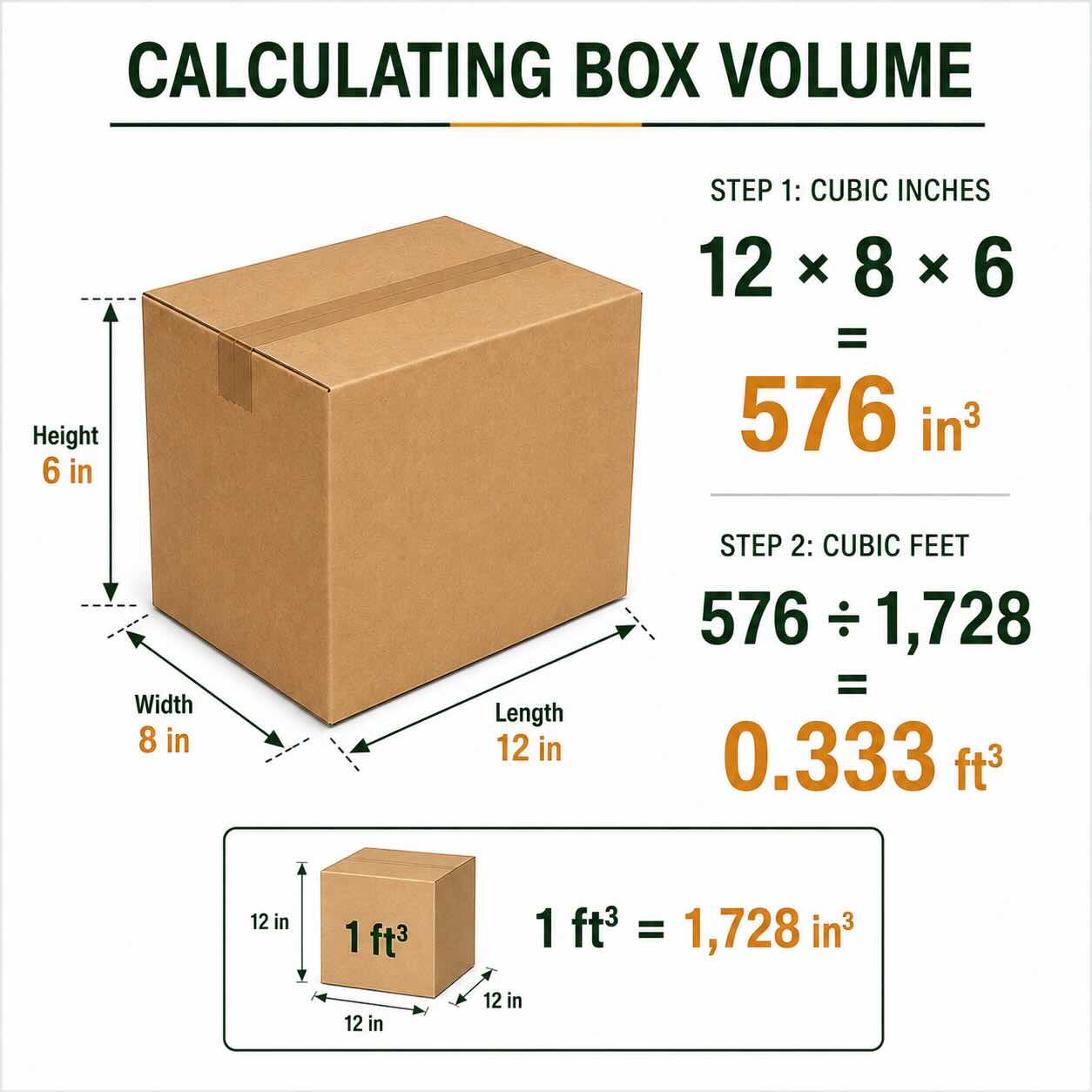
The basic formula for box volume is:
Length × Width × Height = cubic inches
To convert cubic inches to cubic feet:
Cubic inches ÷ 1,728 = cubic feet
The number 1,728 comes from the fact that one cubic foot equals 12 × 12 × 12 inches, or 1,728 cubic inches.
Box dimensions: 12 × 8 × 6 inches
Volume: 12 × 8 × 6 = 576 cubic inches
Convert: 576 ÷ 1,728 ≈ 0.333 cubic feet
For a quantity of 500 boxes:
0.333 × 500 ≈ 166.7 cubic feet
Important limitation: this figure is the mathematical volume represented by the entered outside dimensions. It does not necessarily mean that 500 manufactured empty boxes will require 166.7 cubic feet of actual freight space. Packaging can be shipped flat, folded, nested, collapsed, pre-assembled, bundled, or packed inside larger master cartons with dividers or protective material. Rigid boxes that cannot collapse tend to ship closer to their finished-box volume. Folding cartons shipped flat can occupy dramatically less space than their assembled volume suggests.
Several related but distinct measurements come up when planning packaging shipments, and treating them as interchangeable is a common source of confusion.
| Measurement | What It Tells You | Best Use |
|---|---|---|
| Individual box volume | The mathematical space of one finished box | Comparing box sizes |
| Total theoretical volume | Individual volume multiplied by quantity | Rough early-stage planning |
| Master carton volume | Space occupied by a packed carton of multiple units | Freight and storage planning |
| Pallet volume | Space occupied by a full pallet of cartons | Warehouse and container planning |
| Freight dimensional volume | Volume as calculated by a carrier for chargeable weight | Freight cost estimation, confirmed with a carrier |
None of these numbers should be assumed equal to one another. A theoretical total volume is a useful starting point, not a substitute for a confirmed master carton or freight quotation.
A paper tube is cylindrical, but tubes are almost always shipped inside a rectangular corrugated carton. This creates an important distinction between two very different numbers:
A. The actual cylindrical volume of the tube itself, calculated as π × radius² × length
B. The rectangular space occupied once multiple tubes are arranged together inside a shipping carton
Calculating the cylinder volume of a tube tells you almost nothing about how large a rectangular carton needs to be to hold a quantity of them, because round objects packed together always leave gaps between them. The Paper Tube Shipping Calculator is built to estimate B, the rectangular carton space, not the raw cylindrical material volume.
Diameter is the straight-line measurement across the circular end of the tube, passing through its center. It's easy to confuse with two related measurements:
Radius = Diameter ÷ 2
Circumference = π × Diameter
You do not need to calculate circumference to use this calculator. Simply measure and enter the outside diameter. If a finished tube measures 3 inches across its outside circular face, enter 3 inches as the diameter. Do not convert this figure to circumference.
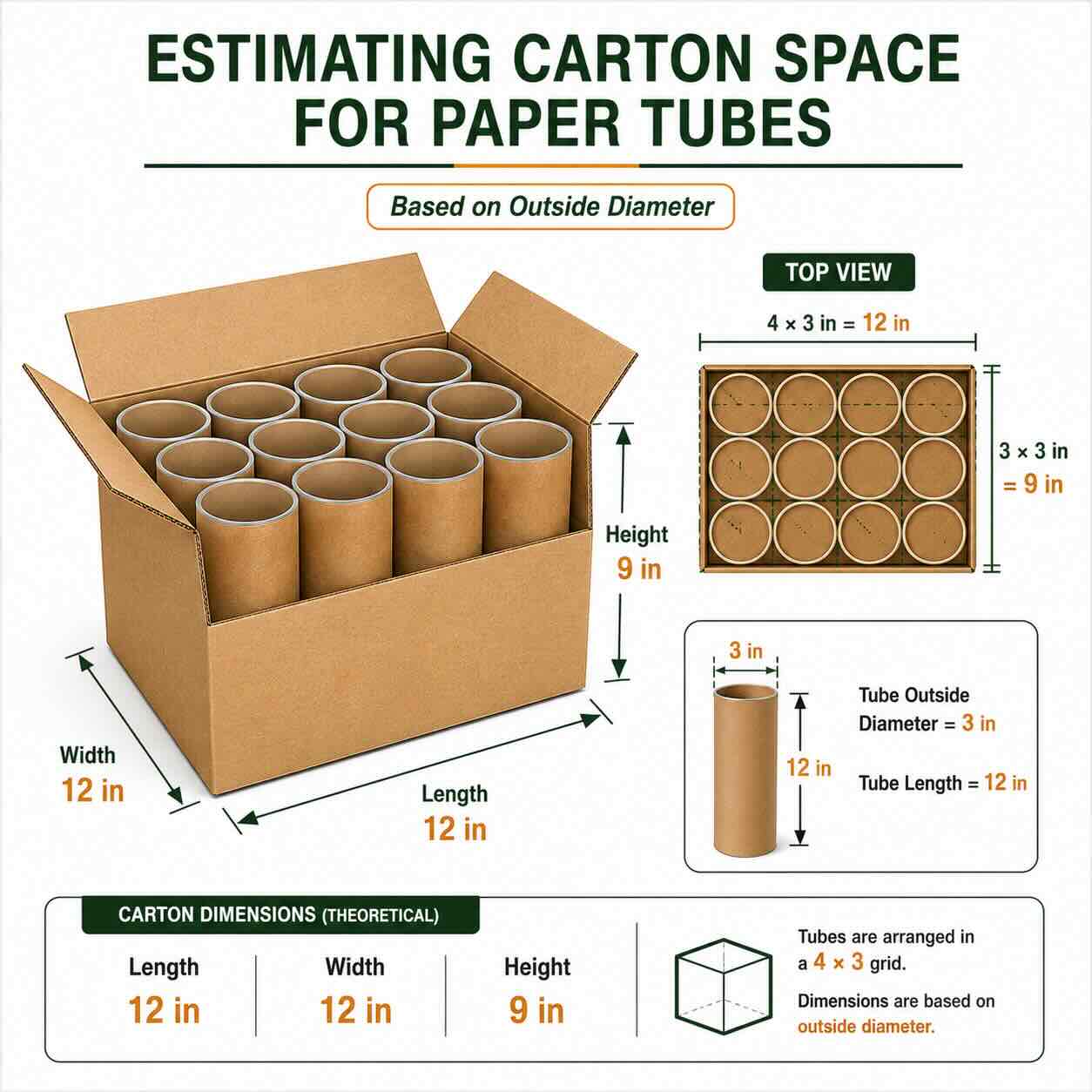
The calculator estimates how tubes can be arranged in simple rows and columns inside a rectangular carton. For example:
Tube diameter: 3 inches
Tube length: 12 inches
Quantity: 12 tubes
A straightforward arrangement might place 4 tubes across and 3 tubes high. The approximate occupied dimensions would then be:
Length: 12 inches (the tube length)
Width: 4 × 3 inches = 12 inches
Height: 3 × 3 inches = 9 inches
Estimated rectangular space: 12 × 12 × 9 inches = 1,296 cubic inches. Converted: 1,296 ÷ 1,728 = 0.75 cubic feet.
This is a simplified theoretical packing estimate based on straight row-and-column arrangement, not a guaranteed production carton size.
Tubes generally cannot be packed into a carton with zero clearance. Actual carton dimensions can be affected by a long list of practical factors, including:
Corrugated board thickness
Tube dimensional tolerance
Caps or lids that extend beyond the tube body
Protective wrapping, polybags, or paper wrapping
Dividers, pads, or edge protection
Carton manufacturing tolerance and packing clearance
Number of layers and tube orientation
Weight limitations and carton strength requirements
Handling requirements and pallet dimensions
For this reason, the calculator's result should be understood as an estimated minimum carton space, not a guaranteed production carton specification. Final master carton dimensions should always be confirmed once production samples or final packaging dimensions are available.
Cylindrical objects can be arranged in more than one pattern. A straight row-and-column layout is the easiest to visualize and calculate. A staggered, or hexagonal, arrangement can use space more efficiently in some cases, since each row nests partially into the gaps of the row below it.
Whether staggered packing is actually practical depends on carton dimensions, tube count, protection requirements, ease of packing on a production line, and how the shipment will be handled afterward. This calculator uses simple rectangular row-and-column packing, which produces an easy-to-understand estimate rather than a more complex, denser packing simulation.
Consider 100 tubes with an outside diameter of 3 inches and a length of 12 inches. Arranged in rows and columns, a practical layout might use 10 tubes across and 10 tubes high, giving estimated occupied dimensions of roughly 12 × 30 × 30 inches, well over 6 cubic feet in a single carton.
At this scale, a manufacturer will often choose to divide the order across several smaller master cartons rather than build one very large carton to hold all 100 tubes at once, which leads directly into the next consideration.
Mathematically fitting an entire order into a single carton does not mean that carton should actually be manufactured or shipped that way. Practical packing decisions also depend on:
Total carton weight
Manual handling requirements
Corrugated strength and crush resistance
Warehouse and carrier handling limitations
Pallet utilization
Ease of counting units during quality checks
Protection of printed surfaces
Overall risk of damage
Manufacturers frequently choose a practical quantity per master carton rather than the mathematical maximum. Instead of packing 500 tubes into one carton, it's often more practical to pack 50 tubes into each of 10 smaller cartons. There is no universal correct quantity; it depends on the product, its weight, and how it will be handled.
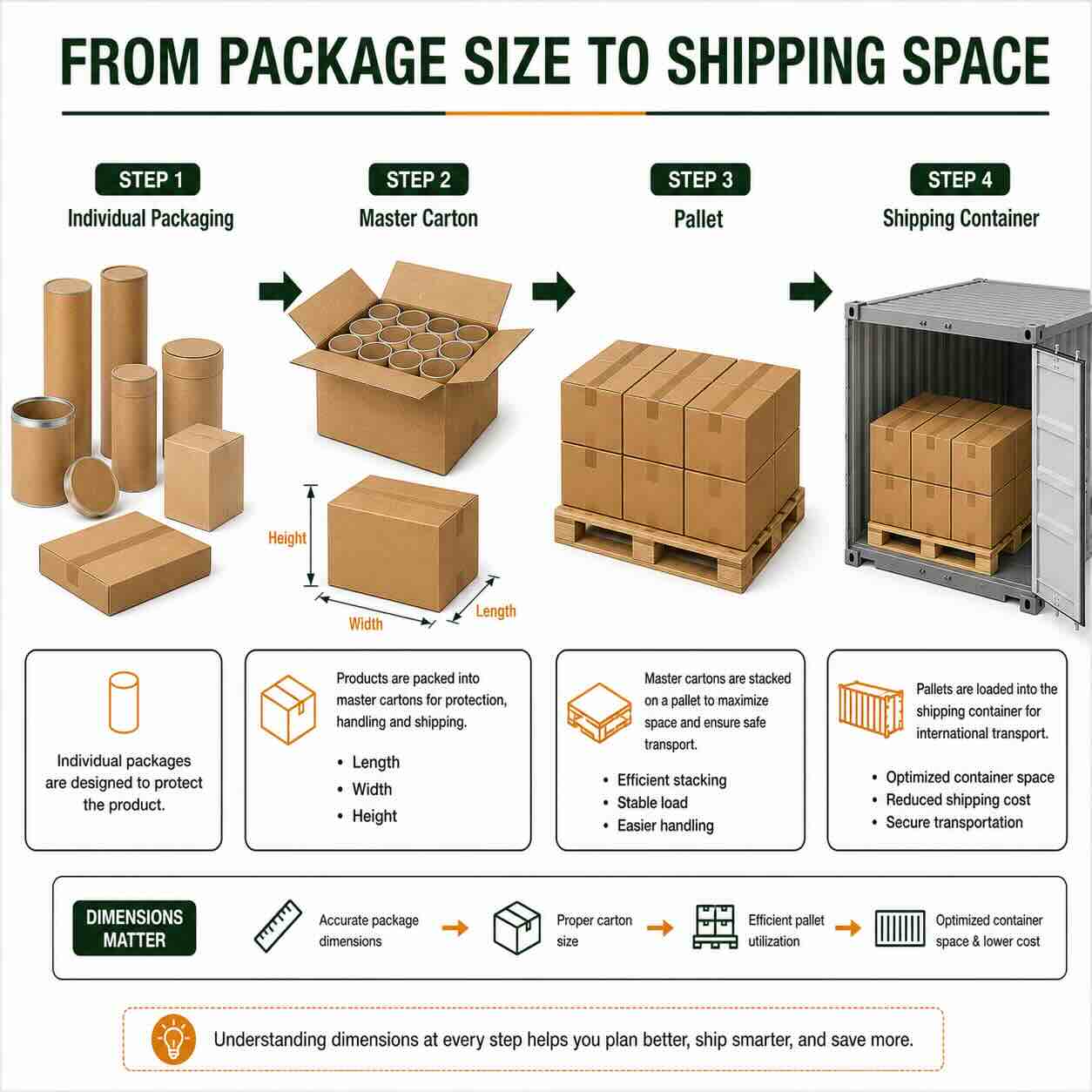
A master carton is the outer shipping carton that groups individual units together for export, freight, warehousing, and distribution. The basic formula is:
Total units ÷ units per master carton = number of master cartons
1,000 tubes ÷ 100 tubes per carton = 10 master cartons
If one master carton measures 24 × 18 × 15 inches:
Volume: 24 × 18 × 15 = 6,480 cubic inches
Convert: 6,480 ÷ 1,728 = 3.75 cubic feet
Total for 10 cartons: 3.75 × 10 = 37.5 cubic feet
Freight carriers commonly consider both physical weight and dimensional (volumetric) weight when calculating charges. A lightweight but bulky shipment, which describes a lot of empty paper packaging, can occupy significant space on a truck, ship, or aircraft even though it weighs relatively little. Carriers may calculate a dimensional weight from the package's dimensions and charge based on whichever figure, actual or dimensional, is higher.
Dimensional weight divisors and calculation methods vary by carrier, shipping method, and country, so this article does not provide a universal formula. Confirm the current divisor and method with your freight forwarder or carrier directly. This is precisely why packaging volume matters for cost planning even when the packaging itself is light.
Air freight:
Volume can strongly affect chargeable weight
Compact packing is often particularly important for cost control
Dimensional weight rules vary by carrier and service level
Sea freight:
Carton and total shipment volume matter significantly, particularly for LCL (less than container load) shipments
Container utilization becomes a key factor for larger orders
This article does not quote current freight rates or state universal carrier rules, since both vary considerably by route, carrier, and market conditions.
In the US, packaging is typically measured in inches, cubic inches, and cubic feet. International freight quotations more commonly use centimeters and cubic meters (CBM). Useful conversions:
1 cubic foot = 1,728 cubic inches
1 cubic meter ≈ 35.315 cubic feet
1 cubic foot ≈ 0.0283 cubic meters
The calculators on this page use inches and cubic feet for simplicity, while international freight quotations you receive may be expressed in CBM.
The standard formula, using meters:
Length × Width × Height = CBM
Carton: 60 cm × 40 cm × 30 cm
Convert to meters: 0.60 × 0.40 × 0.30
= 0.072 CBM per carton
For 100 cartons: 0.072 × 100 = 7.2 CBM
Make sure all dimensions are converted to the same unit before multiplying; mixing centimeters and meters in the same calculation is a common source of error.
Rotating packages can change how efficiently they fit inside a carton. For rectangular boxes, orientation might be flat, upright, or on its side. For tubes, orientation might be horizontal, vertical, or layered in alternating directions. An algorithmic estimate like the calculators on this page tests one straightforward arrangement; it doesn't simulate every possible real-world packing configuration. A packaging engineer or production team reviewing physical samples may identify a more space-efficient arrangement than a simple calculator can.
Buyers should not assume a master carton can be manufactured at exactly the mathematical dimensions calculated from product measurements alone. Reasonable clearance depends on factors including packaging construction, dimensional tolerance, surface protection needs, inserts or dividers, ease of packing on a production line, and the shipping method being used. There is no single universal clearance percentage that applies across all packaging types; the right allowance depends on the specific product and construction.
Custom printed paper tubes and rigid boxes often need extra consideration during shipping, since rubbing and friction in transit can damage printed wraps, matte lamination, foil stamping, embossing, specialty papers, or coated surfaces. This may require tissue interleaving, sleeves, bags, or separators between units, all of which add some amount of shipping volume beyond the bare packaging dimensions.
Not all packaging formats ship the same way relative to their finished dimensions:
Folding cartons often ship flat and are assembled later, occupying a fraction of their finished volume in transit
Rigid cardboard boxes generally cannot collapse and ship closer to their finished dimensions
Paper tubes ship at or near their finished cylindrical dimensions
Telescoping tubes may ship partially nested depending on construction
Rigid setup boxes typically ship pre-assembled and occupy their full finished volume
Boxes with inserts add some volume and weight beyond the box itself
Magnetic rigid boxes ship fully assembled and do not collapse
This is why comparing two packaging options purely by finished dimensions can be misleading. A folding carton and a rigid box with identical finished measurements can require very different amounts of freight space.
Master carton dimensions directly affect how efficiently cartons stack on a pallet, which in turn affects warehouse and container planning. Relevant factors include cartons per layer, number of layers, overall pallet footprint, maximum practical stack height, weight distribution, overhang, and stability during transport. Pallet standards and practical stacking limits vary by market and logistics network, so this article does not state a universal pallet size; check current requirements with your freight forwarder or warehouse.
For cardboard boxes:
Finished length, width, and height
Quantity
Box style
Material
Whether shipped flat or pre-assembled
Inserts or dividers, if any
Printing and finish requirements
Destination
For paper tubes:
Outside diameter
Inside diameter, if technically relevant
Tube length
Quantity
Wall thickness, if specified
Closure or cap style
Printing and finish requirements
Whether individual unit protection is required
Destination
Accurate specifications allow a manufacturer to estimate real packing arrangements far more precisely than dimensions alone.
Enter the outside length
Enter the outside width
Enter the outside height
Enter the quantity
Calculate
The result shows the volume per box and the total theoretical shipping volume for the quantity entered.
Measure the outside diameter of the tube
Enter the tube length
Enter the quantity
Calculate
The result shows an estimated rectangular carton size and volume based on a simple row-and-column arrangement. Do not enter tube circumference; the calculator requires outside diameter only.
These calculators produce estimates for planning and comparison purposes. They are not:
Final master carton specifications
Freight quotations
Guaranteed packing arrangements
Dimensional-weight quotations
Production tolerances
Carrier-approved dimensions
Final packing arrangements should always be confirmed using actual manufactured samples or specifications, together with your selected freight method and carrier.
Multiply outside length × width × height to get cubic inches, then divide by 1,728 to convert to cubic feet.
Calculate the volume in cubic inches first, then divide by 1,728, since one cubic foot equals 1,728 cubic inches.
1,728 cubic inches, based on 12 × 12 × 12 inches.
Outside dimensions, since that reflects the actual space the finished box occupies in a carton, pallet, or container.
Measure the straight-line distance across the circular end of the tube, through its center, using the outside edge of the tube.
No. The calculator requires outside diameter only, not circumference.
Estimate how many tubes fit across and how many rows high in a rectangular arrangement, then calculate the resulting length, width, and height based on those counts and the tube's diameter and length.
Cylinder volume only measures the tube's own material volume. Carton volume accounts for the rectangular space needed to hold multiple round tubes together, including the gaps between them.
A master carton is the outer shipping carton used to group individual packaging units together for export, freight, warehousing, and distribution.
Convert length, width, and height to meters, multiply them together, then multiply by the number of cartons.
It can. Carriers may calculate a dimensional weight from a shipment's volume and charge based on whichever is higher, actual weight or dimensional weight.
Generally no. Most rigid boxes are pre-assembled and ship close to their finished dimensions, unlike folding cartons which can ship flat.
Standard rigid tubes typically do not nest. Certain telescoping tube designs may allow partial nesting depending on construction.
Real-world factors such as board thickness, tolerance, protective wrapping, dividers, and handling requirements all affect final carton dimensions beyond the simple mathematical estimate.
Finished dimensions, quantity, material, printing and finish requirements, whether the packaging ships flat or assembled, and the destination.
Earthycores manufactures custom paper tube and cardboard packaging, including custom sports paper tube and cardboard packaging among other applications. Buyers developing a new packaging project can share product dimensions, order quantity, construction requirements, and destination information so that packing requirements can be evaluated alongside the packaging design itself. As with any calculator-based estimate, final custom packaging dimensions should be confirmed during design and sampling, once real production specifications are available.