How push-and-turn and friction-fit locking mechanisms keep products safe, meet regulatory standards, and stay completely plastic-free — a practical guide for supplement brands serious about sustainable packaging.
There's a moment every supplement brand founder eventually faces. The product is ready. The formula is right. The branding is done. And then someone asks: "Is the packaging child-resistant?" And that question, as simple as it sounds, opens up a whole set of decisions that most brands aren't fully prepared for.
For a long time, child-resistant packaging and sustainable packaging were treated as two separate goals that pulled in opposite directions. Plastic caps, plastic locking mechanisms, plastic everything. If you wanted the safety, you took the plastic. That's changed. In 2026, child-resistant paper tubes have matured into a genuinely viable option for supplement brands ones that don't want to compromise on safety, sustainability, or the way their product looks and feels in a customer's hands.
This guide is written for brand owners and product managers who want to understand how these tubes actually work, which products need them, what certifications matter, and how to make a confident decision before committing to a packaging run.
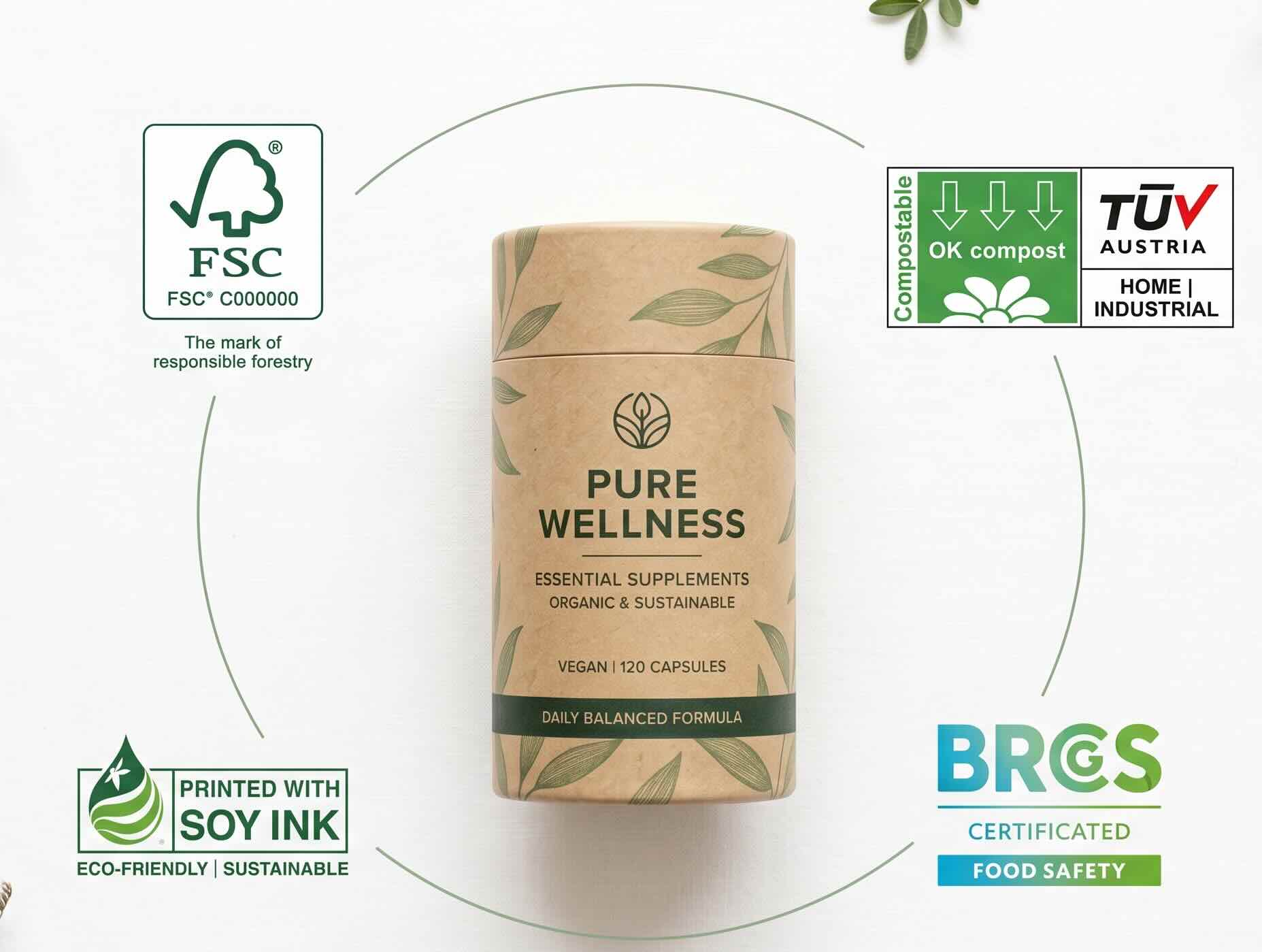
About Earthy Cores: We manufacture sustainable paper tubes with FSC certified paper, BPI certified compostable materials, BRCGS global food-grade standards, and soy ink printing. Every tube we produce is designed to be kind to the planet without cutting corners on protection or presentation. View our full certifications here.
A child-resistant paper tube is a cylindrical cardboard or paperboard container built with a locking closure mechanism that a young child cannot open easily, but that an adult can operate without difficulty. The key word there is "easily." The standard is not that children can never open it. The standard, as defined by regulations like the US Poison Prevention Packaging Act (PPPA) and equivalent EU directives, is that a significant percentage of children in a defined age range cannot open it within a set time window, while a high percentage of adults can.
That distinction matters because it defines what the mechanism needs to do. It doesn't need to be impenetrable. It needs to be genuinely difficult for small hands and developing fine motor skills, while remaining straightforward for an adult who reads the instruction on the cap.
Why Paper Tubes Specifically?
Paper and cardboard tubes offer something no plastic bottle can match in 2026: a fully sustainable, compostable or recyclable structure with premium tactile appeal. As more supplement brands move toward plastic-free commitments and as retail buyers increasingly scrutinise packaging materials, the paper tube is gaining ground fast. Adding a child-resistant mechanism to that structure means you no longer have to choose between safety and sustainability.
The result is a package that protects children, satisfies regulators, impresses wholesale buyers, and aligns with the brand values your customers already expect from you.
This is the section most guides skip, or they describe it so vaguely that you still don't really understand the mechanism. Let's fix that. There are two primary locking systems used in child-resistant paper tubes, and they work in meaningfully different ways.
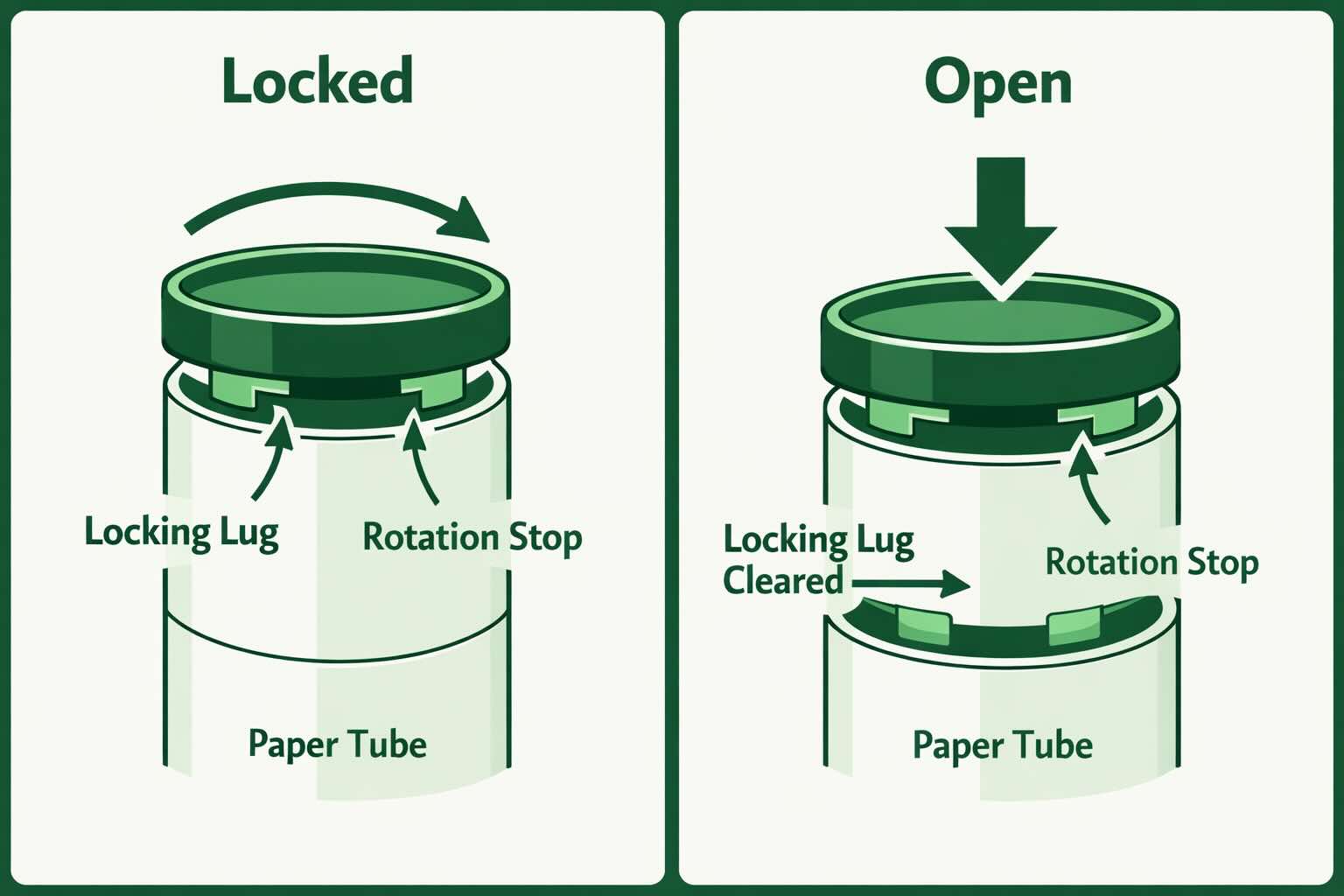
Push-and-turn is the most widely used child-resistant mechanism, adapted from pharmaceutical caps into paper tube format. Here's how it works physically:
The outer cap sits over the top of the tube body. On the inside of the cap, there is a set of raised lugs or tabs moulded into the paperboard or composite material. These lugs rest against corresponding stops on the tube body when the cap is in its resting position. In that resting position, turning the cap does nothing. The lugs hit the stops and the cap goes nowhere.
To open the tube, you have to press down on the cap while simultaneously turning it. Pressing down compresses the cap slightly, lifting the lugs clear of the stops. Once the lugs clear the stops, the cap rotates freely and can be lifted off. Release the downward pressure without turning, and the lugs snap back against the stops.
Push-and-Turn: Step by Step
Step 1: Cap sits on tube body with internal lugs resting against rotation stops.
Step 2: Adult applies downward pressure on cap, compressing it 2 to 3mm.
Step 3: Lugs lift clear of stops as cap compresses downward.
Step 4: Adult simultaneously turns cap, which now rotates freely.
Step 5: Cap lifts off cleanly once rotated past the locking position.
Why children struggle: The action requires simultaneous downward force and rotation, which demands coordination and hand strength that most children under five do not yet have.
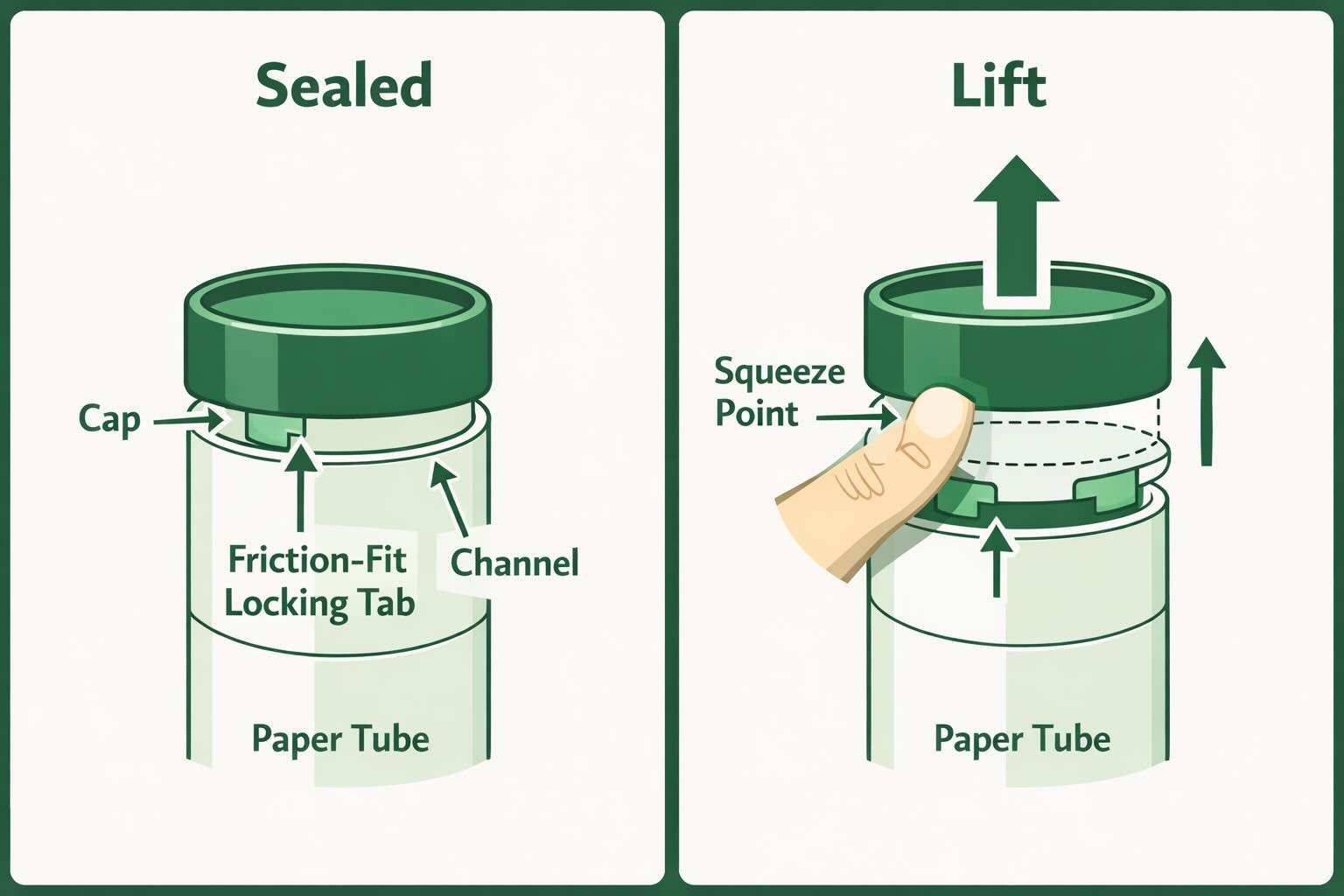
Friction-fit child-resistant closures work differently. Instead of a push-and-turn action, they rely on a precisely calibrated interference fit between the cap and the tube body, combined with a secondary locking tab or channel that must be navigated before the cap releases.
The cap fits snugly over or into the tube with a deliberate level of friction, tight enough that simply pulling upward won't remove it. Inside the cap, a tab or channel is positioned so that the cap must first be squeezed slightly at a specific point or angled in a specific direction before it will release from the tube body. Random pulling, twisting, or levering doesn't work.
For adults, the instruction is simple: squeeze here and lift, or press at this point and pull. For children, who don't read instructions and don't know where to apply force, the mechanism holds. They can pull, they can twist, they can bang it, and the cap stays on.
| Feature | Push-and-Turn | Friction-Fit Lock |
|---|---|---|
| Opening action | Press down and rotate | Squeeze point and lift |
| Coordination required | High (dual action) | Moderate (directional) |
| Reseal ease for adults | Very easy | Easy |
| Plastic-free possible | Yes | Yes |
| Best suited for | Tablets, capsules, supplements | Powders, granules, loose formats |
Both mechanisms can be manufactured entirely from paper and paperboard composites with no plastic components. That's the part that matters most for brands with genuine sustainability commitments. The locking function comes from the geometry and structure of the material, not from a plastic insert hidden inside an otherwise paper package.
This is a question that catches a lot of supplement brands off guard. The assumption is often that child-resistant packaging is only for pharmaceuticals. That's not accurate, and getting it wrong can create both regulatory exposure and reputational risk.
In the US, the PPPA requires child-resistant packaging for any household substance that presents a risk of serious injury or illness to children if ingested. Many supplements qualify under this definition, particularly those with iron content above a threshold level, certain fat-soluble vitamins at high doses, and any product that is also registered or positioned as a therapeutic. In the UK and EU, similar risk-based frameworks apply.
Beyond the legal minimum, there's a much broader question of brand responsibility. Even if your specific product falls outside mandatory requirements, choosing child-resistant packaging for anything a child could potentially access is an increasingly expected standard among health-conscious consumers and retail buyers.
Supplement Products Commonly Requiring Child-Resistant Packaging
Iron supplements and multivitamins with iron above 30mg per unit
High-dose fat-soluble vitamins (A, D, E, K) in concentrated form
CBD and cannabinoid wellness products (required in most US states)
Melatonin, particularly in higher dose formats
Herbal extracts and concentrated botanical supplements
Any supplement positioned alongside or adjacent to pharmaceutical products
Nootropics and cognitive supplements with stimulant ingredients
Pre-workout and sports nutrition with high-dose active ingredients
If your product is sold in multiple markets, the most conservative applicable standard is the one to design for. A tube that passes US PPPA testing and meets EU child-safety directives works everywhere. A tube designed to the minimum of one market may create problems in others.
A Note on CBD and Cannabis-Adjacent Products
In the US, child-resistant packaging for CBD and hemp-derived products is required in virtually every state where these products can be sold legally. It is not optional in practice, even where the specific regulation has nuance. If you're launching or scaling a CBD supplement brand and you're not in child-resistant packaging, it's worth addressing before you reach retail.
For most of the history of child-resistant packaging, the mechanism required plastic. The lugs, the friction tabs, the locking channels — they were made from injection-moulded plastic components because plastic held tolerances tightly enough to make the mechanism reliable. Paper wasn't considered precise enough.
Manufacturing advances in paperboard forming, die-cutting precision, and composite lamination have changed that. It's now possible to engineer child-resistant locking geometry directly into the paperboard structure of the tube cap and body, with tolerances tight enough to pass standardised testing without any plastic components at all.
This is significant beyond the environmental benefit. A tube that is genuinely plastic-free, not just "mostly paper with a plastic insert," can be disposed of through standard paper recycling or home composting depending on the material spec. That's a meaningful end-of-life story you can put on your label and stand behind honestly.
Earthy Cores Certifications and Standards
FSC Certified Paper — timber sourced from responsibly managed forests
BPI Certified Compostable — independently verified compostability
BRCGS Global Standards — food-grade manufacturing and safety
Soy Ink Printing — petroleum-free, lower VOC printing throughout
Biodegradable material options — end-of-life without landfill burden
These certifications aren't marketing badges. They're third-party verified standards that your retail buyers, your B2B partners, and your sustainability-conscious consumers can check independently. In a market where greenwashing is increasingly scrutinised, that independent verification is what separates genuine claims from packaging copy.
One of the underappreciated advantages of paper tubes over plastic bottles is the print surface. A paper tube is essentially a printable cylinder with 360 degrees of brand canvas. There are no recessed panels, no mould lines, no awkward label-wrapping challenges. The surface is flat, smooth, and consistent, which means your artwork lands exactly as your designer intended.
With soy ink printing, the colour quality is excellent and the environmental profile is clean. Soy inks use significantly less petroleum than conventional inks, produce lower volatile organic compound emissions during printing, and are easier to remove during the paper recycling process, which improves the recyclability of the tube overall.
At Earthy Cores, we work with brands from initial concept through to production-ready artwork. Whether you have a fully developed brand identity that needs adapting to tube format, or you're starting from scratch and need guidance on what works well on a cylindrical surface, we can help at whatever stage you're at.
What You Can Customise
Tube diameter and height to match your fill volume exactly
Full 360-degree wrap print in soy inks with up to full-colour output
Matte, soft-touch, or natural kraft finish on outer surface
Cap style: push-and-turn child-resistant or friction-fit lock
Embossing or debossing on cap for tactile brand detail
Window cutout options for product visibility
Inner liner specification for moisture and contamination barrier
Custom insert tray for tablet or capsule presentation
Unique design is not an upsell at Earthy Cores. It's the default. Every tube we produce is built around your product and your brand, not adapted from a generic mould. That's what makes the difference when a customer picks your product up off a shelf next to six others.
Custom sustainable packaging used to come with one of two problems: either the minimum order quantities were so high that small and medium brands couldn't access it, or the lead times were long enough to derail a product launch. We've built our operation specifically to avoid both.
Our minimum order quantities are low enough for independent supplement brands, startups testing a new product line, and established brands wanting to trial a new SKU without committing to warehouse-filling volumes. You don't need to be a large-scale operation to access the same quality of tube that the biggest supplement brands use.
Production is fast. We know that packaging decisions often come later in a product development cycle than they should, and we've structured our production process to accommodate brands that need to move quickly without sacrificing quality. Fast doesn't mean rushed. It means efficient, well-organised, and built around real timelines rather than bureaucratic ones.
How the Order Process Works
1. Share your product details: fill type, fill weight, any regulatory requirements
2. We recommend tube dimensions, wall spec, and locking mechanism
3. You share artwork or we help develop it from your brand guidelines
4. Pre-production sample produced and shipped for your approval
5. Production confirmed on sample sign-off
6. Worldwide delivery on completion
Not all child-resistant paper tubes are equal, and the claims suppliers make don't always hold up when you dig into them. Here are the questions worth asking before you place an order with anyone, including us.
Has the mechanism been independently tested to PPPA or equivalent standards?
Ask for the test report, not just a claim that it's "compliant." Real compliance means a documented test with a defined child age group, a pass rate, and an issuing body. If a supplier can't produce this, the tube may not actually meet the standard.
Is it truly plastic-free or does it contain a plastic locking insert?
Many tubes marketed as paper packaging still contain a plastic locking mechanism hidden inside. Ask specifically: are there any plastic components anywhere in the cap or closure? A "paper tube" with a plastic insert cannot be recycled or composted as paper.
What certifications does the paper stock carry?
FSC certification on the paper stock tells you the fibre was sourced responsibly. BPI compostability certification tells you it has been independently verified to break down under composting conditions. Both are checkable. Ask for the certificate numbers.
Can you see a physical sample before committing to a print run?
Any reputable supplier will provide a pre-production sample. If someone asks you to approve a print run without seeing a physical sample first, that's a significant red flag. The sample is where you test the mechanism, confirm your fill fits, and sign off the print quality.
Follow Earthy Cores
See tube designs, brand projects, and sustainability content across our channels.
Ready to Switch to Child-Resistant Paper Tubes?
Browse our child-resistant tube range or get in touch to discuss your product. Low MOQ, fast production, worldwide delivery, and every certification your buyers will ask for.
Explore Child-Resistant TubesChild-resistant paper tubes have moved from niche innovation to practical option in the past two to three years. The mechanisms work. The certifications are real. The plastic-free claim is now achievable without engineering compromise. And the design possibilities are better than anything a plastic bottle can offer.
If your supplement brand is growing, if you're entering retail channels that scrutinise packaging claims, or if your customers are the kind of people who read the back of the tube before they buy it, child-resistant paper packaging is worth taking seriously in 2026. Not because it's a trend, but because it's the most sensible answer to several problems at once.
At Earthy Cores, we build these tubes every day. If you have questions about mechanisms, dimensions, fill compatibility, or regulatory requirements for your specific product, we're straightforward to talk to. No pressure, no scripts. Just honest answers about whether our tubes are the right fit for what you're making.